
How Does Pallet Netting Work?

A pallet wrapped in solid stretch film looks secure, but underneath the plastic, moisture is often building up. Fresh produce sweats, wooden boxes release humidity, and warm goods condense as they cool — and none of that vapor can escape through a sealed film. Pallet netting solves this by trading a solid barrier for an open mesh that stretches, grips, and breathes at the same time.
This article breaks down the actual mechanics behind pallet netting: how the stretch-and-recovery process locks a load in place, how the mesh structure keeps air moving, and how manual versus machine application changes the result. (For a broader overview of materials and product types, see our guide, What Is Pallet Netting? Uses, Types & How It Works.)
The Core Mechanism: Stretch, Wrap, Recover
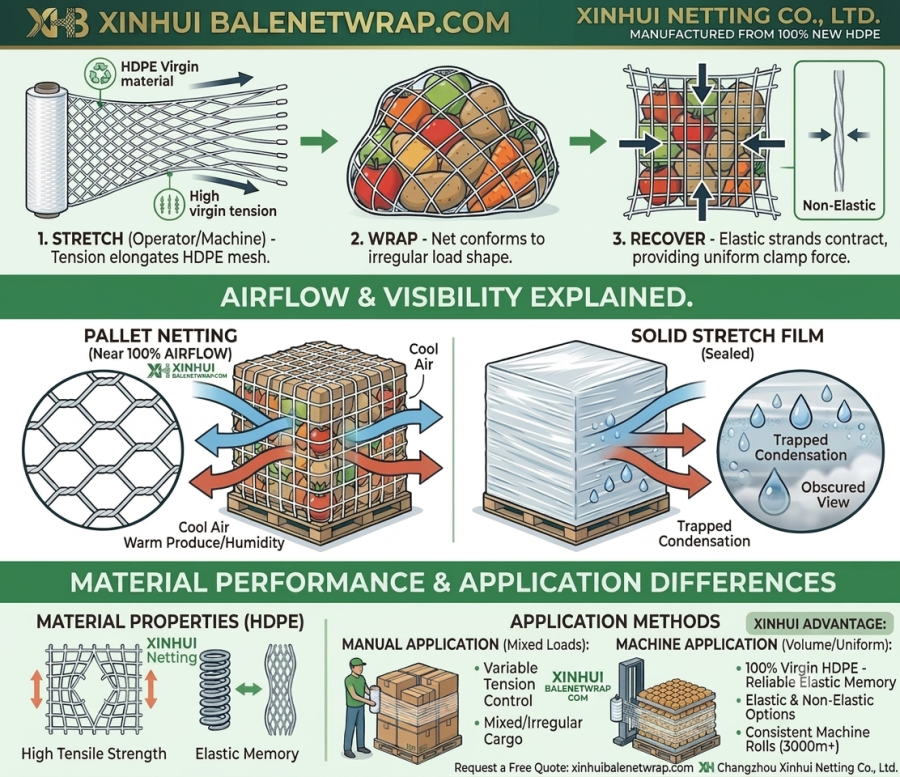
Pallet netting works through a simple physical cycle, repeated with every wrap around the load:
- Stretch – The operator or wrapping machine pulls the net under tension, elongating the HDPE mesh strands.
- Wrap – The stretched net is drawn around the pallet load, layer over layer, following the shape of the cargo.
- Recover – Once tension is released, the elastic strands contract back toward their original length, pulling the mesh tight against the load.
This recovery step is what actually secures the pallet. Because the net is knitted rather than woven, tension applied at any point distributes evenly across the connected mesh — so the netting tightens uniformly instead of pulling unevenly at a single seam, the way solid film sometimes does around irregular shapes.
Elastic vs. Non-Elastic Netting
Not all pallet netting behaves the same way once tension is released, and the difference matters for how a load ends up held.
| Type | Stretch Rate | Behavior After Application | Best Suited For |
|---|---|---|---|
| Elastic pallet net wrap | ~30% | Rebounds and tightens around the load | Irregular, uneven, or mixed-size cargo |
| Non-elastic pallet netting | Minimal/none | Holds fixed tension without rebound | Uniform, stable, rigid pallets |
Elastic netting behaves like the mesh equivalent of a rubber band: stretched during wrapping, it snaps most of the way back toward its original length, and that rebound force is what clamps irregular boxes, crates, or loose produce into a single stable unit. Non-elastic netting skips the rebound step entirely — it’s applied at a set tension and stays there, which is enough for loads that are already square and evenly stacked.
Why the Mesh Structure Allows Airflow
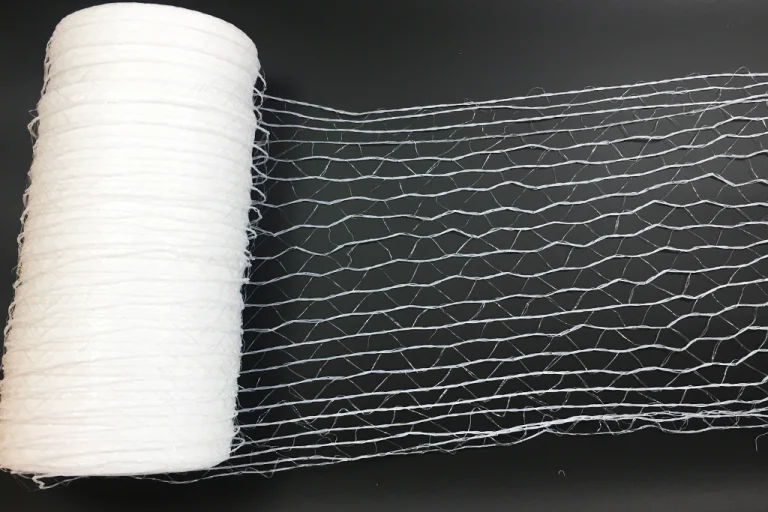
Solid stretch film works by sealing the load inside a continuous plastic layer — effective for keeping out dust and moisture, but it also traps whatever moisture is already inside. Pallet netting is built differently: it’s knitted into an open-grid structure rather than extruded as a continuous sheet, so the gaps between strands stay open even under tension.
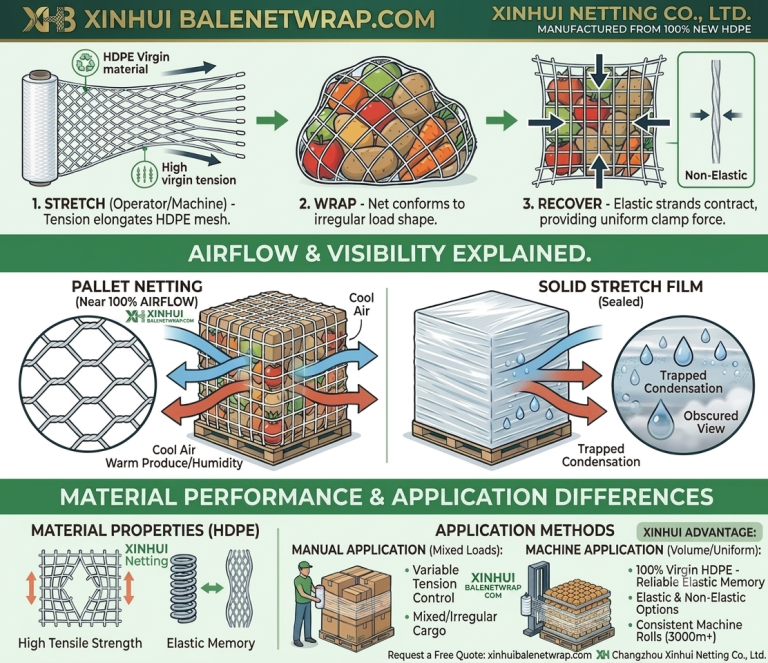
That open structure is what allows near-total air circulation through the load — manufacturers commonly cite figures close to 100% airflow for standard pallet net wrap, compared to a fully sealed film. In practice, that means:
- Field heat and condensation from warm produce can escape instead of pooling inside the wrap.
- Humidity from wooden pallets, crates, or packaging doesn’t get trapped against the goods.
- Visual inspection of the load is possible without removing the wrap, since the mesh is partially see-through.
This is why pallet netting is the default choice, rather than film, for fresh fruit and vegetables, cut flowers, nursery plants, and other cargo where trapped moisture directly causes spoilage.
Manual vs. Machine Application: What Changes
The stretch-wrap-recover mechanism is the same either way, but how it’s carried out changes the netting spec needed.
| Application Method | Typical Roll Length | Tension Control | Typical Use Case |
|---|---|---|---|
| Manual (hand-applied) | 500m – 2,000m | Operator-controlled, variable | Small warehouses, low-volume palletizing, mixed loads |
| Machine (stretch wrapper) | 3,000m – 3,500m | Consistent, machine-set tension | High-volume distribution centers, automated lines |
Machine application produces more consistent tension from the first wrap to the last, which matters most for elastic netting — uneven tension during stretching can cause uneven recovery, leaving some sections looser than others. Manual application relies on the operator maintaining steady pull, which works well for lower volumes but introduces more variation roll to roll.
What Makes the Material Itself Work
The mechanism above only functions because of the material behind it. Pallet netting is knitted from HDPE (High-Density Polyethylene), and two material properties drive its performance:
- Elastic memory – Virgin HDPE strands can be stretched and will return close to their original length repeatedly, which is what makes the recovery step reliable wrap after wrap, roll after roll. Recycled or blended HDPE tends to lose this consistency faster.
- Tensile strength under load – The knitted structure spreads stress across interconnected strands, so the net resists tearing at a single weak point the way a woven material might.
Because the netting is knitted rather than extruded, it also has partial openability — sections can be pulled apart to check contents and then let go, without cutting or fully unwrapping the pallet, which solid film doesn’t allow without damaging it.
Comparing the Result: Netting vs. Solid Stretch Film
| Factor | Pallet Netting | Solid Stretch Film |
|---|---|---|
| Airflow | Near 100% | Sealed, minimal |
| Material used per pallet | Lower (mesh uses less material for equivalent coverage) | Higher (continuous sheet) |
| Load visibility | Yes, mesh is see-through | Limited, depends on film clarity |
| Best for | Produce, plants, ventilated goods | Dust/moisture-sensitive sealed loads |
| Reduction in packaging volume | Up to ~45% less material than solid film for comparable coverage | Baseline |
Neither material is universally “better” — the mechanism each relies on (sealing vs. breathable tensioning) determines which cargo it suits.
FAQ
Q: How does pallet netting actually hold a load in place?
A: The net is stretched during application and then allowed to recover toward its original length. That recovery force pulls the mesh tight against the load, gripping irregular shapes the way a stretched elastic band contracts around an object.
Q: Does pallet netting stretch the same way every time it’s applied?
A: With 100% virgin HDPE, yes — the material’s elastic memory allows consistent stretch and recovery across the length of a roll. Recycled or blended HDPE can lose stretch consistency over repeated use.
Q: Can pallet netting be used with an automatic stretch wrapping machine?
A: Yes. Machine-grade rolls are typically supplied in longer lengths (3,000m–3,500m) so they can run continuously through semi-automatic or fully automatic wrappers without frequent roll changes.
Q: Why does pallet netting allow more airflow than stretch film?
A: Because it’s knitted into an open mesh rather than extruded as a continuous sheet, the gaps between strands stay open even under tension, allowing air to pass through the load instead of being sealed inside.
Q: Is elastic or non-elastic pallet net wrap better for fresh produce?
A: Elastic pallet net wrap is generally preferred for produce, since the rebound after stretching grips irregularly shaped crates and boxes tightly while still allowing airflow.
Changzhou Xinhui Netting Co., Ltd. manufactures pallet netting from 100% new HDPE, in elastic and non-elastic options, for manual and machine application. Request a free quote for custom widths, colors, and roll lengths.


