

Buying Net Wrap in Poland: Import Costs, EU Customs Rules, and Why Factory-Direct Sourcing Makes Sense
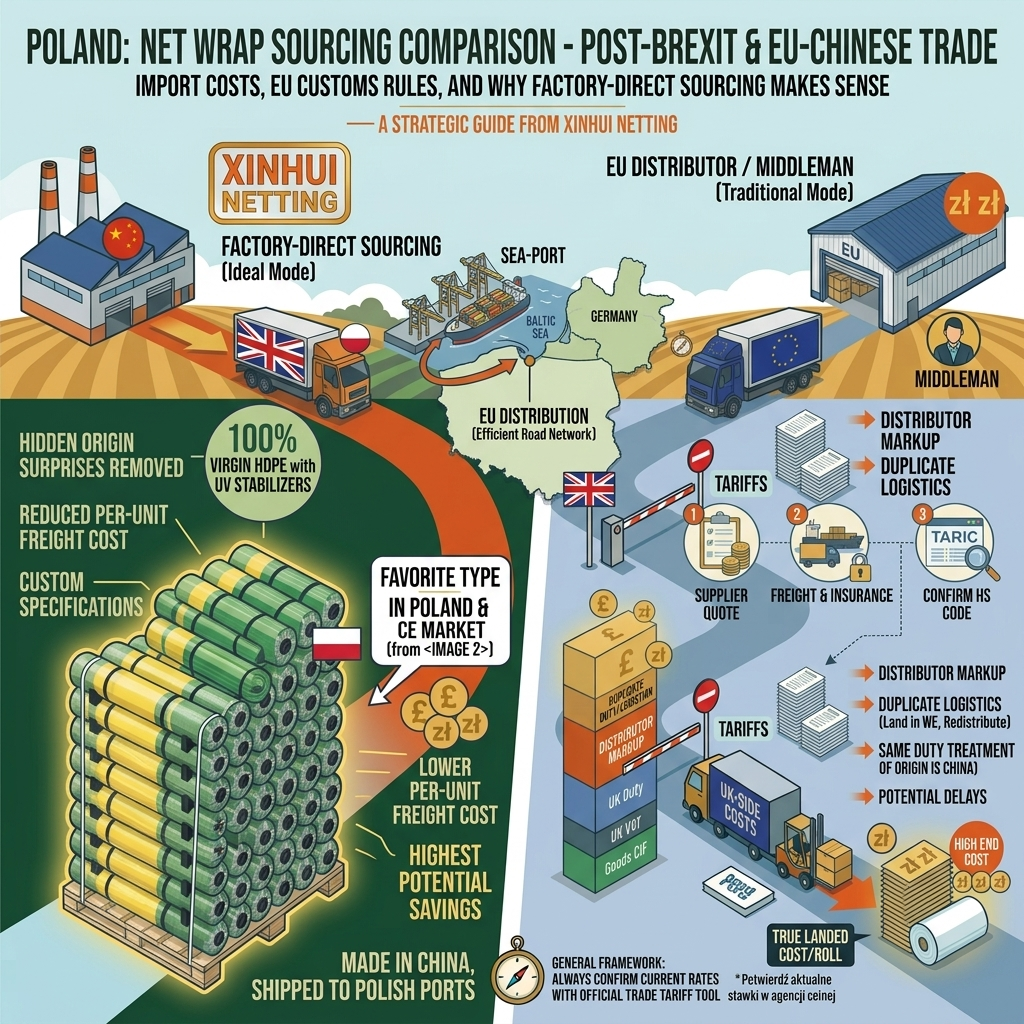
Note: This article explains the general EU customs framework for net wrap imports. It is not customs or legal advice — TARIC codes, duty rates, and VAT treatment can change, so always confirm current rates for your specific product using the European Commission’s TARIC database or a licensed Polish customs agent (agencja celna) before placing a large order.
Poland has become one of the most active agricultural machinery and consumables markets in Central Europe — and increasingly, a logistics hub for redistributing goods across the wider EU. For farms, contractors, and dealers buying bale net wrap in volume, understanding exactly how EU customs duty, VAT, and distributor pricing interact is the difference between a competitive per-roll cost and quietly overpaying through an extra layer of markup that adds nothing to product quality.
This guide walks through how net wrap import costs actually work for a Poland-based buyer, how to calculate a realistic landed cost, and why sourcing factory-direct from a manufacturer is often more cost-effective than buying through a regional distributor — even one based inside the EU.
How EU Customs Duty Applies to Net Wrap from China
China does not have a free trade agreement with the EU, which means goods manufactured in China and imported into Poland (or any EU member state) are subject to the EU’s standard Most Favoured Nation (MFN) duty rates under the Common Customs Tariff — there is no preferential reduction available based on origin alone.
Key points that apply regardless of which EU country receives the shipment:
- TARIC classification determines the rate. Net wrap and related netting products are generally classified under textile or plastics headings depending on material and construction (for example, headings covering knotted netting of twine, cordage, or rope). The specific 10-digit TARIC code determines the exact duty rate, which should be confirmed rather than assumed.
- Duty is calculated on CIF value. Customs duty is applied to the goods’ cost, insurance, and freight (CIF) value — not just the product price.
- Import VAT applies on top of duty. Poland’s standard VAT rate applies to the customs value plus duty, and is generally recoverable for VAT-registered businesses through normal VAT returns, making it a cash-flow cost rather than a permanent one.
- Anti-dumping measures should be checked. The EU maintains anti-dumping duties on a range of specific Chinese product categories — these are tied to exact TARIC codes, so it’s worth confirming none currently apply to your specific classification before ordering.
Because Poland is inside the EU customs union, there’s no Brexit-style “origin loophole” question here — goods entering Poland from China face the same duty and VAT treatment as goods entering any other EU country. The cost difference between suppliers comes down to markup, freight efficiency, and specification accuracy, not customs treatment.
Poland’s Advantage as an EU Sourcing and Distribution Point
For buyers considering factory-direct import, Poland has some practical logistics advantages worth factoring into the decision:
| Factor | Why It Matters |
|---|---|
| Baltic Sea port access (Gdańsk, Gdynia) | Direct container shipping routes from Asia, reducing reliance on Western European transshipment hubs |
| Central location within the EU road network | Efficient onward distribution to Germany, the Baltic states, and Central/Eastern Europe |
| Growing agricultural machinery market | Strong local demand supports larger container orders, improving per-unit freight economics |
| Established customs agency (agencja celna) network | Experienced local brokers familiar with agricultural netting classifications |
These factors make Poland a genuinely competitive entry point for factory-direct container orders, rather than only a market that has to rely on goods first landing in Western Europe and being redistributed at an additional markup.
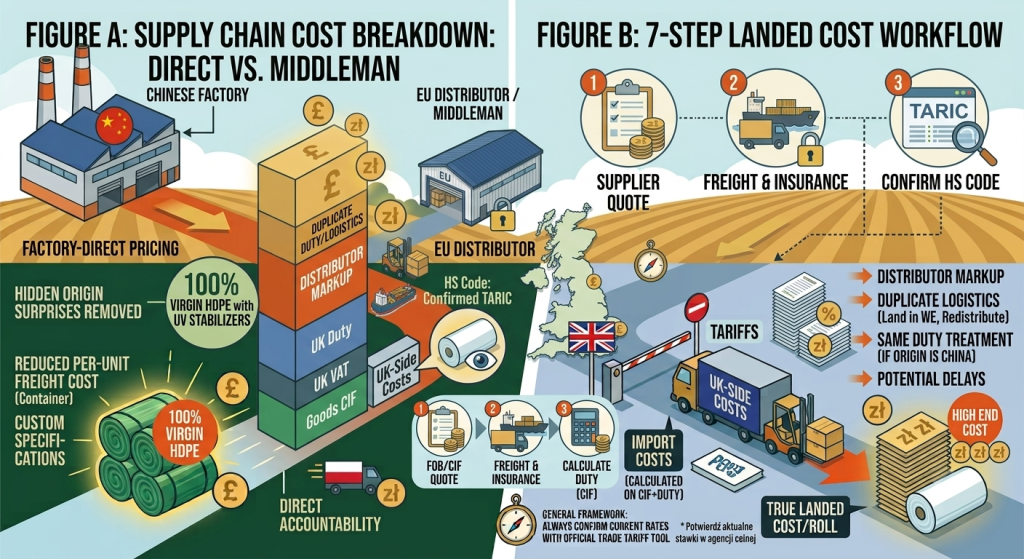
Hands-On: How to Calculate Your True Landed Cost in Poland
Step 1 — Get a clear FOB or CIF quote from your supplier. Confirm exactly what’s included, since these terms are sometimes used loosely in early-stage quotes.
Step 2 — Add freight and insurance if not already included. Get a quote to your intended port of entry (commonly Gdańsk or Gdynia) if you received an FOB price.
Step 3 — Confirm the exact TARIC code. Use the EU’s TARIC database with a precise product description — material composition, weave/knit construction, and intended use — to identify the correct classification.
Step 4 — Check the duty rate and any anti-dumping measures for that code. Confirm both before finalizing your cost model.
Step 5 — Calculate duty on the CIF value. Apply the confirmed rate to your total goods, freight, and insurance cost.
Step 6 — Add Polish import VAT. Calculated on the CIF value plus duty; confirm the current standard rate, as VAT rates are periodically reviewed.
Step 7 — Add local costs. Include port handling, customs agency fees, and inland transport to your warehouse.
Step 8 — Divide by roll count. Compare this true landed cost per roll against any distributor quote — remembering that VAT is generally recoverable for VAT-registered businesses, so it’s a cash-flow consideration rather than a permanent cost difference between routes.
Why Factory-Direct Pricing Makes Sense for Polish Buyers
- No hidden re-exporter markup. A significant portion of “European” net wrap sold by distributors is manufactured outside the EU and simply imported and resold — the distributor already paid duty and VAT before adding their own margin on top.
- Container-volume freight efficiency. Ordering directly in full container quantities typically brings per-roll freight costs down substantially compared to buying smaller restocks from a regional distributor.
- Specification control without a markup layer. Requesting specific roll widths, weights (g/m²), colors, or private-label packaging is more straightforward — and cheaper — when negotiated directly with the manufacturer.
- Consistent supply for larger operations. Poland’s growing scale of mechanized farming and contracting operations makes container-level ordering directly from a factory increasingly practical, rather than only suited to very large distributors.

What to Look for in a Factory-Direct Net Wrap Supplier
- Manufacturing using 100% virgin HDPE with UV stabilizers, rather than reprocessed material blends that degrade faster in variable Central European weather conditions
- A documented range of roll widths and weights (for example, 48″–67″ widths and 7–12 g/m²) to match different baler brands common across the Polish and Central European market
- Experience shipping to Baltic and Northern European ports with realistic container lead times
- OEM/private-label packaging options for distributors reselling under their own brand
- Willingness to provide samples or a trial order before a full container commitment
Xinhui Netting, based in Changzhou, China, manufactures bale net wrap in a range of widths (48″–67″) and weights (7–12 g/m²), using 100% virgin HDPE with UV stabilizers, from a 25,000㎡ facility, and has export experience supplying agricultural customers across Europe, North America, South America, and Australia.
FAQ
Q: Does China have a free trade agreement with the EU that reduces net wrap duty?
A: No — China does not have a free trade agreement with the EU, so net wrap imported from China into Poland or any EU member state is subject to the standard MFN duty rate under the EU’s Common Customs Tariff, based on its TARIC classification.
Q: What determines the exact duty rate for net wrap imported into Poland?
A: The 10-digit TARIC code assigned based on the product’s material composition and construction — small classification differences can lead to different duty rates, so this should be confirmed rather than assumed from a general product description.
Q: Is Polish import VAT a permanent added cost?
A: For VAT-registered businesses, import VAT is generally recoverable through normal VAT returns, making it primarily a cash-flow timing cost rather than a permanent expense — though it still needs to be paid at the point of import.
Q: Are there EU anti-dumping duties on net wrap from China?
A: The EU maintains anti-dumping duties on various Chinese product categories, tied to specific TARIC codes — it’s worth checking the current EU trade defence database for your exact classification before ordering, since these measures can change.
Q: Why would a Polish buyer choose factory-direct sourcing over a European distributor?
A: Because many “European” net wrap suppliers are actually reselling Chinese-manufactured product after paying the same duty and VAT themselves, buying factory-direct typically removes that extra distributor markup without changing the underlying customs costs.
Q: Is Poland a good entry point for container-direct net wrap imports into Central Europe?
A: Yes — Baltic Sea port access combined with central road connectivity across the EU makes Poland a practical logistics hub for buyers looking to import directly and distribute across Central and Eastern Europe.
Changzhou Xinhui Netting Co., Ltd. Professional Net Wrap Manufacturer | OEM & Private Label | Factory Direct Pricing
📧 : sale1@xinhuibalenetwrap.com
🌐 : https://xinhuibalenetwrap.com
Request a Free Quote Today →
Supplying farms, co-operatives, and distributors across North America, Europe, Japan, Australia, and worldwide.


