
What Size Twine Do I Need for a Round Baler?
Choosing the right round baler twine isn’t just about grabbing whatever roll is on the shelf — it’s about matching roll length and strength rating to your bale size and baler type. Get it wrong, and you’ll end up with snapped knots, loose bales, or wasted product. This guide breaks down the real industry-standard sizes, explains the difference between tensile strength and knot strength, and shows you exactly how much hay twine you’ll need per bale.
Quick Answer: Standard Round Baler Twine Sizes
Round balers typically use one of two twine types, sold in much longer rolls than square baler twine:
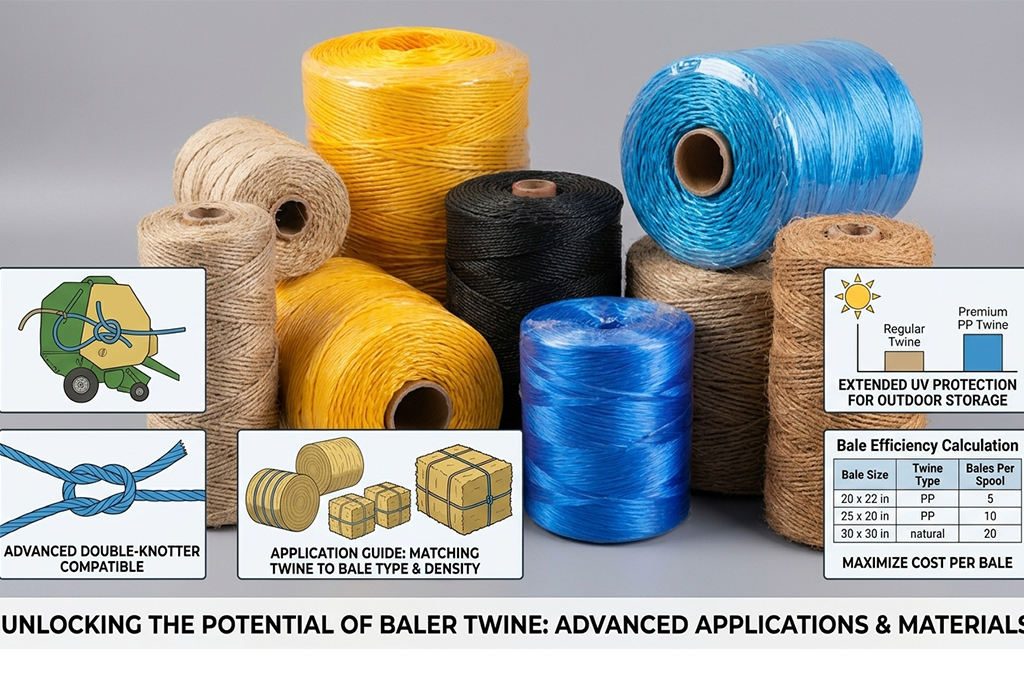
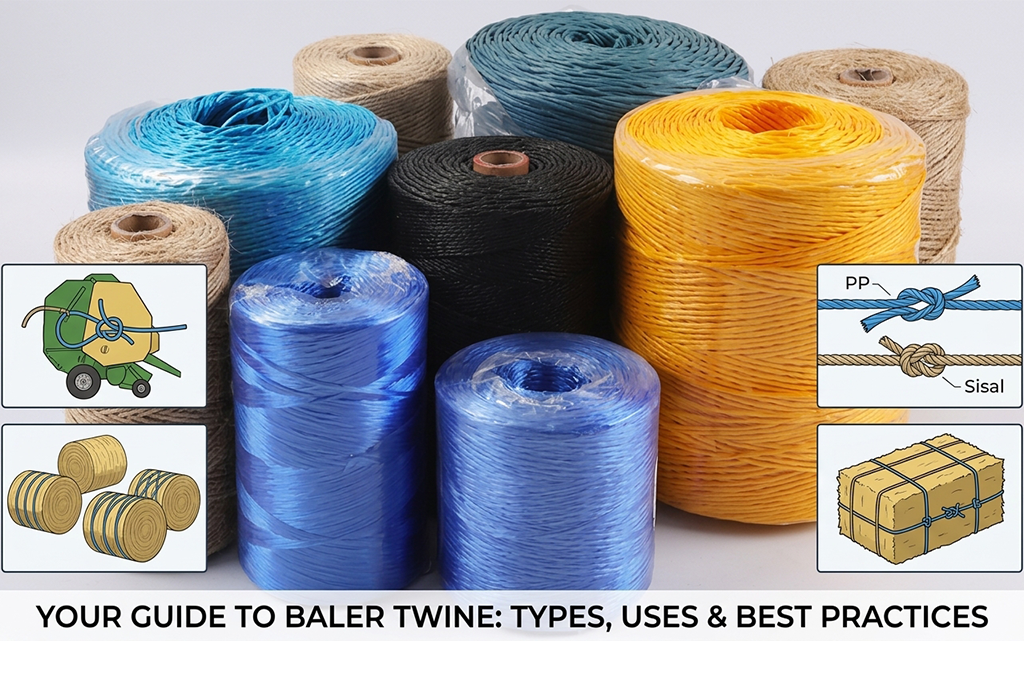
- Polypropylene (plastic) baler twine: The modern industry standard, most commonly sold in 20,000-foot “Big Ball” rolls, rated by tensile strength — usually 110 to 150 lbs.
- Sisal baler twine: A natural-fiber alternative, commonly available in 16,000-foot rolls for round balers (shorter 7,200–9,600 ft rolls are typically made for small square balers instead).
The key thing to remember: round baler twine is rated by tensile strength, not knot strength. Since round balers don’t tie a knot the way square balers do, tensile strength — the force needed to break the twine itself — is the number that actually matters here.
Tensile Strength vs. Knot Strength: Know the Difference
This is one of the most misunderstood points when shopping for baler twine:
- Tensile strength measures how much force the twine can withstand before it snaps. This is the relevant spec for round bale twine, since round balers wrap and cut twine rather than tying knots.
- Knot strength measures how much force a tied knot can withstand before failing. This applies to square baler twine, where the knotter mechanism ties each strand together.
Because of this difference, square baler twine (small or large) is rated much higher on paper — ranging from around 130 lbs for small square bales up to 350–700+ lbs for dense, heavy large square bales — while round baler twine sits in a lower but perfectly adequate 110–150 lb tensile range for its application.
Round Baler Twine Sizes: What’s Actually on the Market
Based on current supplier specifications, here’s what a typical round baler twine lineup looks like:
| Twine Type | Roll Length | Strength Rating | Best For | |
|---|---|---|---|---|
| Poly (plastic) “Big Ball” | 20,000 ft | 110 lb tensile | Standard round bales (~1,200 lbs) | |
| Poly (plastic) “Big Ball” | 20,000 ft | 130–150 lb tensile | Denser round bales (~1,800 lbs) | |
| Sisal | 16,000 ft | Moderate tensile | Round bales, natural-fiber preference | |
| Solar-degradable poly | 20,000 ft | 110 lb tensile | Round bales left outdoors long-term |
By contrast, small square baler twine (7,200–9,600 ft rolls) and large square baler twine (4,000–4,850 ft rolls) are shorter but far stronger per foot, since square balers rely on knot strength rather than raw tensile force.
Sisal Twine vs. Plastic Twine for Round Balers
Both materials work well on modern round balers, but each has trade-offs:
- Sisal baler twine: Fully biodegradable, safer if livestock accidentally consume small amounts, and a traditional choice for many cattle operations. Sisal round bale twine is generally sold in 16,000-foot rolls.
- Polypropylene baler twine: More weather- and UV-resistant, holds up better in wet or long-term outdoor storage, and is the more common choice for high-volume operations due to its 20,000-foot roll length and lighter overall spool weight.
If you’re baling hay that will be stored outside for months, plastic twine’s UV resistance gives it an edge. If your bales go straight to feeding livestock, sisal’s biodegradability is worth the trade-off.
How Much Twine Do You Need Per Round Bale?
The most accurate way to estimate your twine for round baler needs is with a simple formula:
Bale diameter × 3.14 (circumference) × number of wraps = twine length per bale
For example, a 5-foot-diameter round bale has a circumference of about 15.7 feet. If your baler applies 16–20 wraps, that’s roughly 250–315 feet of twine per bale — though this varies by baler settings and bale density.
Based on real product data from twine suppliers, a 20,000-foot roll of poly twine typically ties 45 to 55 large round bales, depending on bale weight (heavier 1,800 lb bales use more wraps and thus more twine per bale than lighter 1,200 lb bales). A 16,000-foot sisal roll will tie proportionally fewer bales — generally in the 35–45 bale range — though always check your specific baler’s wrap settings for the most accurate count.
How to Choose the Right Twine for Your Baler
Match your twine choice to these four factors:
- Bale weight and density: Heavier, tightly packed bales need the higher end of the tensile strength range (130–150 lbs) to avoid snapping.
- Storage conditions: Bales stored outdoors for extended periods benefit from UV-resistant plastic twine or solar-degradable poly options designed to break down predictably.
- Livestock safety: If bales will be fed with twine still attached (not recommended, but it happens), sisal’s biodegradability reduces risk.
- Baler manufacturer specs: Always check your operator’s manual — some brands specify a preferred twine tension arm setting that pairs best with a particular roll thickness.
Where to Buy Round Baler Twine
Round baler twine is widely available at farm supply retailers such as Tractor Supply and Rural King, as well as through bulk agricultural suppliers online. When comparing baler twine for sale, look beyond the sticker price and check:
- Price per foot, not just price per roll
- Tensile strength rating (for round bale twine) or knot strength (for square bale twine)
- Roll length and material type
- Whether solar-degradable or high-visibility (orange) options are available for your storage needs
Buying in bulk typically lowers your cost per roll significantly, especially if you’re running multiple balers through a full hay season.
Tips for Getting the Most Out of Your Twine
- Store rolls in a dry, temperature-stable location — moisture and heat both weaken twine over time, sisal especially
- Match your twine box and tension arm settings to the roll length and thickness you’re using
- Keep a spare roll on hand during peak baling season to avoid mid-field downtime
- If switching between sisal and poly twine, re-check your knotter or twine box tension, since the two materials behave slightly differently under the same settings
Frequently Asked Questions
What size twine is used for a round baler?
Round balers most commonly use 20,000-foot polypropylene (plastic) twine rated at 110–150 lbs tensile strength, or 16,000-foot sisal twine as a natural-fiber alternative.
Is round baler twine measured in knot strength or tensile strength?
Round baler twine is measured in tensile strength, not knot strength. Knot strength applies to square baler twine, which is tied into a knot by the baler’s knotter mechanism.
How many round bales can one roll of twine make?
A 20,000-foot roll of polypropylene twine typically ties 45 to 55 large round bales, depending on bale weight and the number of wraps your baler applies. A 16,000-foot sisal roll ties somewhat fewer, generally in the 35–45 bale range.
Is sisal or plastic twine better for round balers?
Sisal twine is biodegradable and safer if accidentally ingested by livestock, while polypropylene twine offers better UV and weather resistance, making it the more common choice for bales stored outdoors long-term.
How do I calculate how much twine I need per bale?
Multiply your bale’s diameter by 3.14 to get the circumference, then multiply by the number of wraps your baler applies. This gives a close estimate of twine length used per bale.
Can I use square baler twine on a round baler?
No — square baler twine is rated by knot strength and designed for a knotter mechanism, while round balers require twine rated by tensile strength and are built for different tension arm and roll dimensions.
Changzhou Xinhui Netting Co., Ltd. Professional baler twine suppliers | OEM & Private Label | Factory Direct Pricing
📧 : sale1@xinhuibalenetwrap.com
🌐 : https://xinhuibalenetwrap.com
Request a Free Quote Today →
Supplying farms, co-operatives, and distributors across North America, Europe, Japan, Australia, and worldwide.


