Straw Protection Fleece: How to Protect Straw Bales Outdoors
Storing straw bales outdoors can help farms and agricultural businesses save valuable indoor storage space. However, rain, wind, sunlight, and changing weather conditions can gradually affect the quality of stored straw. Without suitable protection, moisture may penetrate the bale stack, increasing the risk of mold, discoloration, and material loss.
Straw protection fleece provides a practical solution for outdoor straw bale storage. Made from polypropylene (PP), this specialized agricultural covering combines water-repellent performance with breathability, helping shed rainwater while allowing moisture vapor to escape.
For farmers, hay producers, agricultural distributors, and wholesale buyers, choosing the right straw bale cover and installing it correctly are essential for effective long-term protection. This guide explains how to protect straw bales outdoors, how to install straw protection fleece, and what to consider when selecting a covering for agricultural use.

Why Do Straw Bales Need Outdoor Protection?
Straw bales stored in fields or open yards are exposed to several environmental factors. Even when straw is properly baled, prolonged exposure to unfavorable weather can reduce its storage quality.
The main risks include:
- Rain and surface moisture: Repeated rainfall can wet the outer layers of a bale stack, especially when the covering is poorly fitted or water collects on its surface.
- Trapped moisture: Condensation beneath an unsuitable cover can create damp conditions and increase the risk of mold.
- Wind damage: Strong winds may lift, loosen, or tear an improperly secured cover.
- UV exposure: Prolonged sunlight can gradually degrade covering materials that are not designed for outdoor use.
- Storage costs: Keeping every bale inside a warehouse or barn may require significant space and investment.
A suitable outdoor covering helps reduce these risks. The goal is not simply to block rain, but to manage water, moisture vapor, and wind while maintaining a stable covering over the entire bale stack.
How Does Straw Protection Fleece Work?
Straw protection fleece is a specialized agricultural textile designed for outdoor protection of straw and hay bales. Polypropylene fleece products are commonly engineered to repel rainwater while remaining permeable to air or moisture vapor.
Unlike an ordinary impermeable plastic sheet, a breathable straw bale cover helps moisture escape from beneath the covering. This can reduce condensation-related problems when the fleece is installed correctly and the straw is sufficiently dry before storage.
The main performance characteristics to consider are:
1. Water-Repellent Surface
A water-repellent treatment helps rainwater run off the surface instead of immediately soaking into the covering. Proper installation is equally important: the fleece should form a sloping surface so water can drain away rather than collect in depressions.
2. Breathable Structure
Breathability allows moisture vapor to escape from the covered stack. This is particularly useful for outdoor storage because moisture trapped beneath an unsuitable covering can contribute to damp conditions.
Breathable fleece does not eliminate every moisture risk. Wet straw, poor drainage, and incorrect installation can still cause storage problems.
3. UV-Resistant Material
Straw protection fleece intended for outdoor use can incorporate UV additives to help resist sunlight-related degradation. Actual service life depends on the material specification, UV exposure, local climate, installation, and handling.
4. Flexible and Practical Handling
Fleece can be supplied in different widths and lengths to suit various bale stacks. Selecting the correct dimensions helps reduce unnecessary overlaps, simplify installation, and improve coverage.
How to Protect Straw Bales Outdoors: Step-by-Step
Correct installation is just as important as selecting the right covering. Follow these steps to improve outdoor storage protection.
Step 1: Choose a Suitable Storage Location
Whenever possible, place straw bales on well-drained, relatively level ground. Avoid low areas where rainwater collects or where runoff may flow toward the stack.
Good drainage helps reduce moisture exposure from below. If ground conditions are consistently wet, consider a suitable raised or otherwise protected storage base.
Step 2: Stack the Bales Correctly
Arrange the bales in a stable stack that allows rainwater to drain from the top. A sloping or pitched profile is generally preferable to a flat surface because it reduces the likelihood of standing water.
Keep the stack stable and avoid creating deep depressions between bales. The final shape should support smooth coverage without large gaps or loose sections.
Step 3: Check Straw Condition Before Covering
Whenever practical, store straw that is adequately dry for its intended use. Covering material that is already excessively wet does not solve the underlying moisture problem.
Inspect the stack for wet areas, damaged bales, and other issues before installing the fleece. Address these problems first rather than relying on the covering to correct them.
Step 4: Select the Correct Straw Protection Fleece
Choose a fleece designed for outdoor agricultural bale protection. Check the material, grammage, dimensions, water-repellent treatment, UV resistance, and seam construction.
The required size depends on the stack width, height, length, roof profile, and the amount of material needed to extend down the sides. Measure the complete stack before ordering rather than selecting a cover based only on the bale dimensions.
Step 5: Position the Fleece Over the Stack
Unroll or unfold the covering carefully and position it so the top and sides are protected. Keep the material reasonably taut and smooth, avoiding large wrinkles or depressions that could collect water.
Where the product has designated orientation or installation instructions, follow the manufacturer’s guidance.
Step 6: Secure the Edges and Overlaps
Secure the fleece using suitable fixing accessories, such as compatible hook-and-loop fasteners, ground-fixing nails with washers, or other recommended fixing systems.
The edges should remain stable during windy conditions, but avoid fastening methods that unnecessarily damage the fabric. Where multiple panels are needed, make sure the joins are arranged to maintain practical weather protection.
Do not assume that a heavier cover can compensate for poor fixing. Correct dimensions, adequate edge security, and a suitable stack shape all contribute to reliable performance.
Step 7: Inspect the Cover Regularly
Check the covering after strong winds, heavy rain, or other severe weather. Look for loose edges, damaged seams, standing water, and exposed areas.
Remove accumulated debris where necessary and repair or replace damaged sections according to the manufacturer’s instructions. Regular inspection helps identify minor issues before they affect a larger portion of the stack.
Straw Protection Fleece vs. Ordinary Tarpaulins
Not every covering material performs the same way in outdoor bale storage. The key distinction is how it manages rainwater and moisture vapor.
| Comparison Factor | Straw Protection Fleece | Ordinary Impermeable Tarpaulin |
|---|---|---|
| Main purpose | Outdoor straw and hay bale protection | General-purpose weather covering |
| Breathability | Designed to allow air or moisture vapor to pass through, depending on construction | Typically limited when made from impermeable plastic |
| Water management | Water-repellent surface helps shed rain | Can block rain, but water may collect on the surface if poorly installed |
| Condensation management | Breathability can help reduce moisture trapped beneath the cover | Trapped moisture may be a concern when ventilation is insufficient |
| UV performance | Depends on UV additives and product specifications | Depends on the material and UV stabilization |
| Installation | Requires correct slope, coverage, and fixing | Also requires appropriate slope and secure fixing |
| Best selection criteria | Breathability, water repellency, grammage, dimensions, and UV resistance | Waterproofing needs, durability, dimensions, and fastening |
Which option is better for outdoor straw storage?
For applications where moisture vapor needs to escape, a purpose-made breathable straw protection fleece may be more suitable than an ordinary impermeable sheet. However, no covering can compensate for excessively wet straw, poor drainage, or incorrect installation. Product specifications and local weather conditions should guide the final choice.
How to Choose the Right Straw Bale Cover
The most suitable straw bale cover depends on storage conditions, bale-stack dimensions, and expected service requirements.
Consider the Grammage
Grammage, expressed in grams per square meter (g/m²), indicates the mass of the fabric per unit area. It is an important specification, but it does not independently determine overall quality.
When comparing different weights, also evaluate tear resistance, seam strength, UV stabilization, water-repellent performance, and handling requirements.
Match the Dimensions to the Bale Stack
A cover should extend over the top and down the sides of the stack, with sufficient material for proper positioning and fastening.
Measure the stack’s length, width, and height, taking the roof shape and required edge coverage into account. For large agricultural operations, custom dimensions may help improve material utilization and simplify installation.
Check the Material and UV Specification
Polypropylene (PP) fleece with UV additives is a common option for outdoor agricultural applications. Ask suppliers for the material specification and any available information on UV performance, durability, and recommended use.
Avoid comparing products based only on their names or appearance. Similar-looking covers may have different material structures and performance characteristics.
Evaluate Stitching and Fixing Accessories
Strong seams help maintain the integrity of the cover, especially during repeated handling and outdoor exposure.
Common options include overlock seams, which finish the edges to help prevent fraying, and double-needle straight stitching, which provides two parallel stitch lines. Compatible fixing accessories can also make installation and maintenance easier.
Straw Protection Fleece Specifications for Wholesale Buyers
Agricultural distributors and importers should confirm product specifications before placing bulk orders. The following table summarizes the main options available for this type of covering.
| Specification | Typical Options |
|---|---|
| Product | Straw Protection Fleece / Straw Bale Protection Fleece |
| Material | Polypropylene (PP) filament with UV additives |
| Standard grammage | 140 g/m² |
| Other available grammages | 100, 150, and 160 g/m²; confirm current production availability |
| Colors | Green, white, black, or customized |
| Standard sizes | 6 × 12.5 m, 9.8 × 12.5 m, 9.8 × 25 m, 10.4 × 12.5 m, 10.4 × 25 m, 12 × 25 m, and 15.6 × 25 m |
| Surface treatment | Shaping and water-repellent treatment |
| Stitching | Overlock seam or double-needle straight stitch |
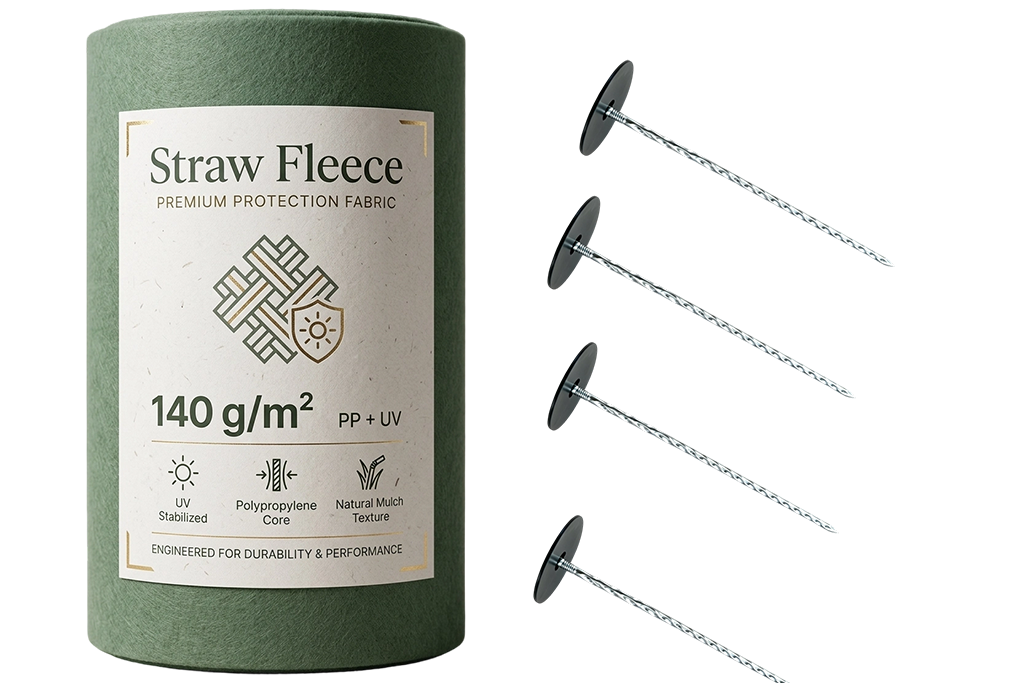
| Fixing accessories | Hook-and-loop fasteners and ground-fixing nails with washers |
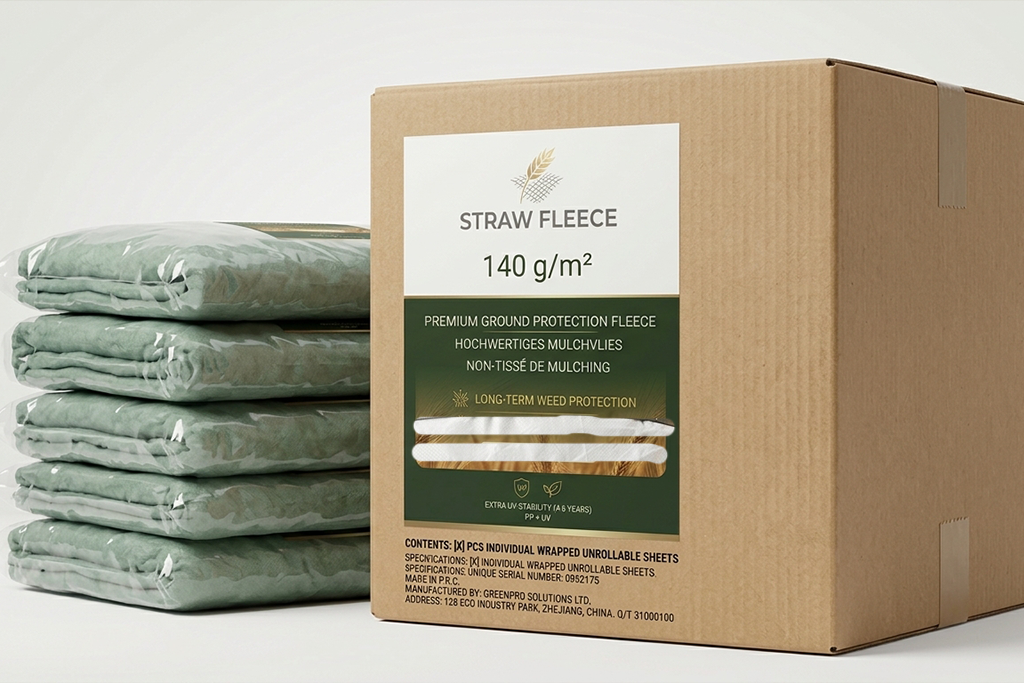
| Packaging | Roll packaging, folded carton packaging, or bulk woven bags |
| Wholesale MOQ | 1 metric ton, subject to order confirmation |
| Customization | Sizes, colors, stitching, labels, and packaging options |
Specifications can vary by production order. Confirm the final grammage range, dimensions, treatment, packaging, and minimum order quantity with the supplier before publishing a product specification or confirming a purchase.
Common Mistakes to Avoid When Covering Straw Bales
Even a suitable fleece may deliver poor results when installation or storage practices are incorrect. Avoid these common mistakes:
- Covering wet straw without inspection: A covering cannot remove excessive moisture already present in the bales.
- Leaving a flat or uneven top: Depressions can collect rainwater and place unnecessary stress on the covering.
- Using an undersized cover: Insufficient material may leave the sides exposed or make secure fastening difficult.
- Leaving edges loose: Wind can lift the fleece, allowing rain to enter and increasing the risk of damage.
- Assuming water-repellent means fully waterproof: Breathable fleece is designed to manage water and moisture differently from an impermeable membrane.
- Ignoring weather-related damage: Periodic checks help identify loose fasteners, torn seams, and exposed sections.
A consistent storage procedure, combined with a suitable covering, can help maintain better conditions throughout the storage period.
What Should Agricultural Wholesale Buyers Look For?
For distributors, importers, and agricultural product wholesalers, product performance is only one part of a successful purchase. Reliable specifications and practical supply arrangements also matter.
Before ordering straw protection fleece in bulk, consider the following:
- Consistent specifications: Confirm grammage, dimensions, material, treatment, stitching, and color.
- Customization options: Check whether the manufacturer can supply custom sizes, private labels, and branded packaging.
- Packaging and transportation: Select roll, folded-carton, or bulk packaging according to your warehouse, handling, and distribution requirements.
- Fixing accessories: Confirm whether compatible fasteners can be included in the order.
- Order quantity and lead time: Check the minimum order quantity, production schedule, and shipping arrangements before confirming a purchase.
- Samples and quality checks: Where appropriate, evaluate samples and agree on the specifications that will be used for production approval.
Working directly with a manufacturer can make it easier to coordinate product customization and bulk packaging. For distributors serving different agricultural markets, a clear specification sheet also helps maintain consistency across repeat orders.
Frequently Asked Questions
1. What is straw protection fleece used for?
Straw protection fleece is an agricultural covering designed to protect straw bales stored outdoors. Depending on the product specification, it can also be used for hay bale storage and other outdoor agricultural covering applications.
2. Is straw protection fleece waterproof?
Straw protection fleece is generally designed to be water-repellent and breathable rather than completely waterproof. It helps shed rainwater while allowing moisture vapor to escape. Performance depends on the product construction, weather conditions, and correct installation.
3. How do I install straw protection fleece correctly?
Prepare a stable, well-drained bale stack with a sloping top. Position the fleece smoothly over the stack, avoid depressions, and secure the edges with compatible fixing accessories. Inspect the cover periodically, especially after severe weather.
4. What grammage should I choose for straw bale protection?
The appropriate grammage depends on the intended application, handling requirements, and expected outdoor exposure. A 140 g/m² option is a common standard for this product range, but buyers should compare the full specifications rather than relying on grammage alone.
5. Can straw protection fleece be reused?
Some UV-stabilized straw protection fleeces are designed for repeated seasonal use. Actual service life depends on UV exposure, weather, installation, storage between uses, and the product’s construction. Inspect the material before reuse.
6. What sizes are available for straw bale protection fleece?
Standard dimensions may include 6 × 12.5 m, 9.8 × 12.5 m, 9.8 × 25 m, 10.4 × 12.5 m, 10.4 × 25 m, 12 × 25 m, and 15.6 × 25 m. Custom dimensions may be available for different bale-stack layouts.
7. Can wholesale buyers customize straw protection fleece?
Yes. Depending on the order and production requirements, customization may include dimensions, colors, stitching methods, labels, packaging, and fixing accessories. Confirm available options and the minimum order quantity with the manufacturer.
Conclusion: Choose the Right Cover for Outdoor Straw Storage
Protecting straw bales outdoors requires more than simply placing a sheet over the stack. Suitable ground conditions, a stable sloping stack, a correctly sized covering, secure fastening, and regular inspection all help reduce weather-related storage risks.
Straw protection fleece offers agricultural businesses a practical covering option by combining water repellency, breathability, and UV-stabilized material. Choosing the right grammage and dimensions—and installing the fleece correctly—can help improve outdoor bale storage management.
For farms, agricultural distributors, and importers looking for customized products, explore our Straw Bale Protection Fleece for available specifications, custom sizing, stitching options, fixing accessories, and wholesale supply.
Contact our team to discuss your required dimensions, grammage, packaging, and order quantity.