What Is Baler Twine? A Complete Guide for Hay and Straw Baling

Baler twine is a strong agricultural tying material used to secure hay, straw, forage, and other baled crops after they are compressed by a baler. It plays an important role in keeping a bale compact, stable, and easy to handle during storage, transportation, and feeding.
For farmers and hay producers, choosing the right baler twine is not simply a matter of buying the strongest product available. The correct twine needs to match the type of baler, bale size, bale density, tying system, and intended storage conditions.
Baler twine is commonly used with both round balers and square balers, including small square balers and large square balers. Depending on the application, farmers can choose from different twine materials, lengths, thicknesses, and strength ratings.
This guide explains what baler twine is, what baler twine is made of, how it works, how much twine is used per bale, and how to choose the right twine for your baler.
What Is Baler Twine?
Baler twine is a specialized agricultural twine designed to tie compressed bales of hay, straw, grass, alfalfa, and other forage materials. Unlike ordinary household or general-purpose twine, baler twine is manufactured to withstand the tension and mechanical stress created during the baling process.
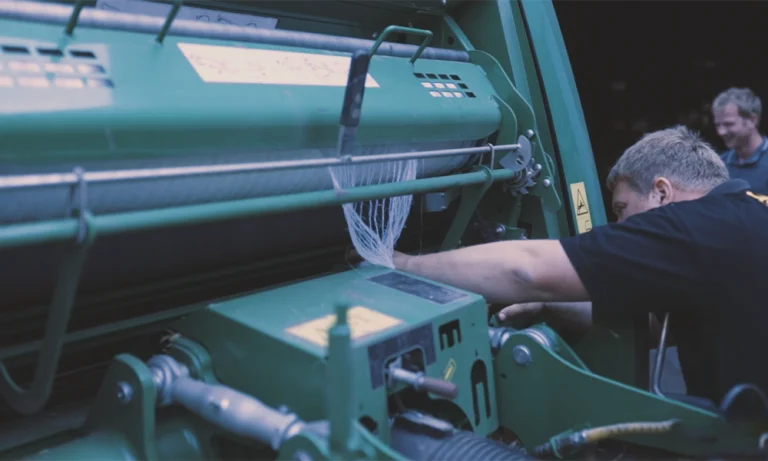
During baling, the crop material is compressed inside the baler chamber. Once the desired bale density and size are reached, the baler feeds twine around or through the bale and creates one or more knots to hold the material together.
A good baler twine needs to provide several important characteristics:
- High tensile strength
- Good knot strength
- Consistent diameter
- Reliable knot formation
- Resistance to stretching
- Resistance to moisture and weather
- Consistent feeding through the baler
- Sufficient length per roll
The exact requirements depend on the baler and the type of bale being produced.
For example, a dense large square bale places considerably more stress on the tying material than a smaller, less dense bale. Therefore, the baler twine size and strength should always be selected according to the baler’s requirements.
What Is Baler Twine Made Of?
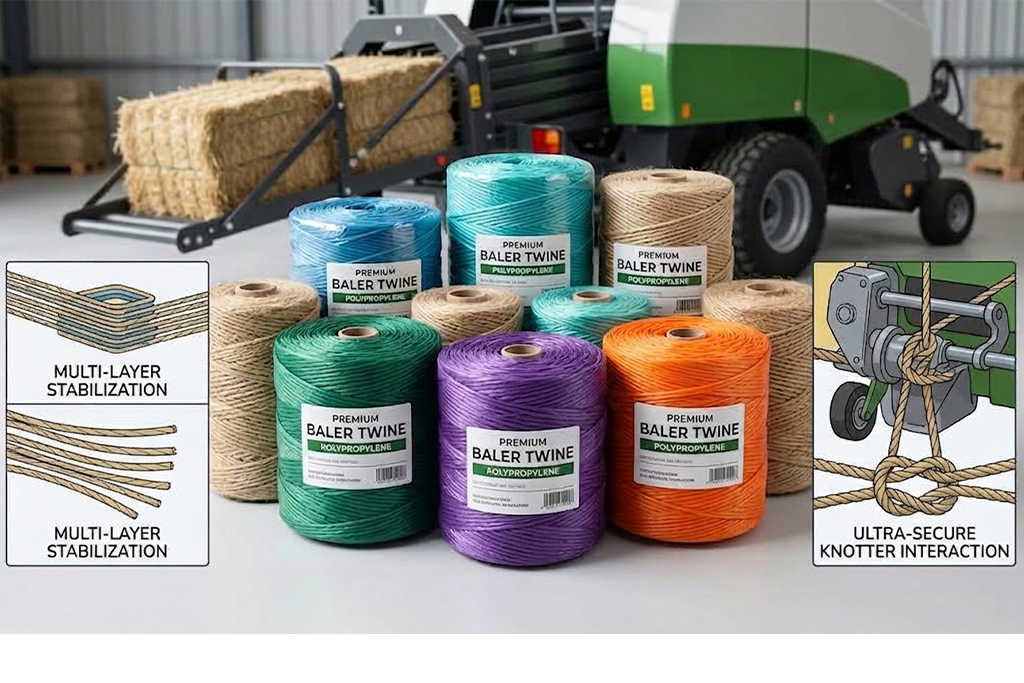
Baler twine is generally manufactured from either polypropylene (PP) or sisal, although the characteristics of these materials are quite different.
Polypropylene Baler Twine
Polypropylene is a synthetic plastic material widely used for agricultural baler twine. PP baler twine is popular because it offers a combination of strength, durability, light weight, and resistance to moisture.
High-quality polypropylene baler twine is manufactured with controlled fiber extrusion and twisting processes to achieve consistent diameter and strength.
The main advantages of polypropylene baler twine include:
- Good tensile strength
- High resistance to moisture
- Good resistance to rot
- Lightweight construction
- Consistent diameter
- Smooth feeding through the baler
- Long storage life
- Available in different lengths and strength ratings
Polypropylene twine is particularly suitable for farmers who need consistent performance during large-scale hay and straw baling operations.
Sisal Baler Twine
Sisal baler twine is made from natural sisal fiber obtained from the leaves of the sisal plant. It has traditionally been used for tying hay and straw bales.
Sisal is a natural fiber, so its performance characteristics differ from polypropylene. It can be attractive for users who prefer a natural agricultural tying material, but it is generally more sensitive to moisture and storage conditions than synthetic polypropylene twine.
When comparing sisal baler twine vs polypropylene baler twine, farmers should consider strength, moisture resistance, storage conditions, bale density, cost, and disposal requirements rather than looking at material alone.
How Does a Hay Baler Tie the Twine?
A hay baler uses a mechanical tying system to position the twine around the compressed crop and form a knot.
Although the exact mechanism varies between baler models, the general process is similar.
First, hay or straw enters the baling chamber and is compressed into a bale. When the bale reaches the required size or density, the baler activates its tying system.
The twine is then fed from the twine box through a series of guides and tensioning components. The tying mechanism positions the twine around the bale before the knotter creates a secure knot.
After the knot is completed, the twine is cut and the bale is released from the chamber.
This automated process allows farmers to produce large numbers of consistent bales without manually tying each bale.
The quality of the final knot depends on several factors, including:
- Twine quality
- Twine diameter
- Twine strength
- Twine tension
- Knotter condition
- Knife condition
- Bale density
- Correct machine adjustment
This is why using the correct baler twine is important for reliable baler operation.

What Size Twine Do I Need for a Round Baler?
One of the most common questions from farmers is what size twine for a round baler.
There is no single twine size that works for every round baler. The correct choice depends on the baler model, bale diameter, crop type, bale density, and manufacturer’s specifications.
A round bale made from dry hay may require different twine performance from a very dense bale made from heavy forage.
When choosing twine for a round baler, consider:
- Recommended twine strength
- Twine length per roll
- Twine diameter
- Bale diameter
- Bale density
- Number of wraps
- Crop type
- Storage conditions
Always check the baler manufacturer’s recommendations before selecting a twine specification.
A properly selected twine should run smoothly through the machine and create secure knots without excessive breakage or stretching.
What Size Twine Do I Need for a Square Baler?
The answer to what size twine for a square baler also depends on the specific baler and bale configuration.
Small square balers generally use twine specifications designed for smaller and lighter bales, while large square balers produce heavier and denser bales and therefore require stronger tying material.
For a square baler, the important specifications include:
- Twine strength
- Knot strength
- Twine length
- Bale size
- Bale density
- Number of tying strings
- Baler manufacturer’s recommendations
Using twine that is too weak can result in broken twine, loose knots, or bales that lose their shape during transportation.
Using a suitable high-quality twine helps maintain bale integrity from the baler to the storage area and ultimately to the end user.
How Strong Is Baler Twine?
Baler twine strength is usually evaluated by its tensile strength and knot strength.
Tensile strength refers to the amount of pulling force the twine can withstand before breaking. Knot strength refers to how much force the twine can withstand when it has been tied into a knot.
Knot strength is especially important for baler twine because the finished bale is held together by knots rather than by a continuous piece of unbroken twine.
A twine may have high straight-line tensile strength but perform poorly if its knot strength is low.
For this reason, farmers should consider both tensile strength and knot performance when selecting baler twine.
High-quality manufacturing also helps ensure that the twine has a consistent diameter and strength along the entire roll. Inconsistent twine can contribute to knotting problems and unexpected breakage.
How Much Twine Does a Bale Use?
Another important question is how many bales per roll of twine.
The answer varies depending on the type of baler, bale size, number of twine lines, tying pattern, and length of the twine roll.
For example, the number of round bales per roll of twine will depend on the bale diameter and the number of wraps used around each bale.
Similarly, the number of square bales per roll of twine depends on bale dimensions and how many strings are applied to each bale.
A simple calculation can be made using:
Number of bales per roll = Total usable twine length ÷ Twine used per bale
However, actual consumption can vary because the baler uses additional twine for knots, tails, and the tying process.
Farmers should therefore use actual baling results when estimating seasonal twine requirements.
How Many Bales Can One Roll of Baler Twine Make?
There is no universal answer to how many bales one roll can produce.
The result depends on:
- Twine length per roll
- Bale size
- Bale diameter
- Number of twine wraps or lines
- Knotting method
- Bale density
- Baler settings
- Crop type
For example, a longer roll can produce more bales, but a larger and denser bale may consume more twine per bale.
When comparing two rolls of baler twine, it is therefore better to compare usable length, strength, and cost per bale, rather than comparing roll weight alone.
How to Choose the Right Baler Twine
Choosing the right baler twine starts with identifying the requirements of your baler.
1. Check Your Baler Manufacturer’s Recommendation
The first step is to check the manufacturer’s recommended twine specification. This is especially important for high-density balers and large square balers.
2. Match the Twine Strength to Bale Density
Higher-density bales place more tension on the tying material. If you are producing heavy or tightly compressed bales, select twine with sufficient tensile and knot strength.
3. Consider Twine Length
Twine length determines how many bales you can produce from one roll. Longer rolls may reduce the frequency of changing rolls and can improve efficiency during large baling operations.
4. Consider Crop Type
Hay, straw, alfalfa, and other forage crops can have different densities and handling characteristics. The twine should be strong enough for the specific crop and bale configuration.
5. Consider Storage Conditions
If bales will be stored outdoors or exposed to humid conditions, moisture resistance becomes particularly important.
6. Consider Total Cost per Bale
The cheapest roll is not necessarily the cheapest option.
A better comparison is:
Total twine cost ÷ Number of bales produced
This helps farmers understand the real cost of the tying material.
Baler Twine vs Net Wrap
Baler twine is not the only way to secure a bale. Round balers can also use net wrap.
Baler twine remains popular because it can be economical and is compatible with many conventional baling systems. Net wrap, on the other hand, can provide faster bale coverage and may offer advantages for certain round-bale applications.
The choice between baler twine and net wrap depends on the baler, crop, storage conditions, operating speed, and farmer preference.
For farmers already using a twine-based tying system, selecting a reliable baler twine that matches the machine can be a practical and cost-effective solution.
Common Baler Twine Problems
Even when the correct twine is selected, problems can occur if the baler is not properly adjusted.
Common issues include:
Twine Breaking
If baler twine keeps breaking, check the twine strength, tension setting, knotter condition, twine path, and bale density.
Loose Knots
Loose knots may be caused by incorrect tension, worn knotter components, unsuitable twine, or incorrect machine settings.
Missed Knots
Missed knots can result from problems with the knotter, twine tension, twine positioning, or worn components.
Twine Cutting Problems
The baler twine knives need to remain sharp and correctly positioned. A damaged or dull knife can interfere with clean twine cutting.
Regular maintenance of the knotter, twine knives, guides, and tensioning system can help reduce tying problems.
How to Store Baler Twine
Proper storage is important for maintaining twine quality before use.
Baler twine should ideally be stored in a clean and dry location away from direct sunlight, excessive heat, and moisture.
Keep the original packaging intact until the twine is needed. Avoid storing rolls directly on wet floors or in locations where they can be exposed to rain or condensation.
For polypropylene baler twine, protecting the product from prolonged UV exposure is also important because excessive ultraviolet exposure can gradually affect polymer performance.
Good storage practices help maintain the original strength and consistency of the twine.
Frequently Asked Questions About Baler Twine
Is baler twine stronger than regular twine?
Yes. Baler twine is specifically manufactured for agricultural baling applications and is designed to withstand the tension, compression, and knotting forces associated with baling.
Can I use the same twine for round and square balers?
Not necessarily. Different balers and bale sizes have different requirements. Always check the recommended twine specification for your particular machine.
Is polypropylene baler twine waterproof?
Polypropylene has good resistance to moisture and does not absorb water like many natural fibers. However, storage and UV exposure should still be considered when using it outdoors.
How do I know which baler twine to buy?
Start with your baler model and manufacturer’s recommended twine specification. Then consider bale size, bale density, crop type, required strength, roll length, and storage conditions.
Where can I buy baler twine in bulk?
Farmers, hay producers, agricultural contractors, distributors, and retailers can purchase baler twine in bulk from agricultural supply companies and specialized baler twine manufacturers.
For large-volume purchases, buyers should compare not only the price per roll but also twine length, strength, packaging, bale yield, and shipping cost.
Conclusion
Baler twine is a critical consumable for many hay and straw baling operations. It keeps compressed crops securely tied and helps maintain bale shape during handling, transportation, and storage.
Understanding what baler twine is, what baler twine is made of, how a hay baler ties twine, what size twine is suitable for a round or square baler, and how many bales can be produced from one roll can help farmers make a better purchasing decision.
Polypropylene and sisal are two common materials, with each offering different performance characteristics. The best choice depends on the baler, crop, bale density, storage conditions, and operating requirements.
Before purchasing, always confirm the required twine specification for your baler and compare strength, knot performance, roll length, and cost per bale. Choosing the right baler twine can help reduce breakage, improve knot reliability, minimize downtime, and keep bales secure from the field to storage.
FAQ
Frequently Asked Questions About Baler Twine
What is baler twine?
Baler twine is a strong agricultural twine used to tie and secure hay, straw, alfalfa, and other forage crops into bales. It is commonly made from polypropylene (PP) or natural sisal and is designed to work with round, small square, and large square balers.
What is baler twine made of?
Baler twine is mainly made from polypropylene (PP) or sisal. Polypropylene twine is lightweight, moisture-resistant, UV-stabilized, and widely used for modern hay and straw baling. Sisal twine is made from natural plant fibers and is biodegradable.
What size twine for round baler?
The appropriate twine size for a round baler depends on the baler model, bale density, crop type, and manufacturer’s recommendations. Fine or medium-strength twine is commonly used for round bales, while heavier twine may be required for high-density or heavier bales.
What size twine for square baler?
The correct twine size depends on whether you are using a small square baler or a large square baler. Small square balers generally use lighter twine, while large square balers require stronger twine designed for higher bale density and greater tying loads.
How does a hay baler tie the twine?
A hay baler feeds twine around the bale and uses a knotter mechanism to form a knot that holds the bale together. The twine is cut after the knot is completed, allowing the baler to begin tying the next bale.
How many bales per roll of twine?
The number of bales per roll depends on the roll length, bale size, number of ties or wraps, and baler settings. To estimate the number of bales, divide the total twine length in the roll by the approximate amount of twine used per bale.
How strong is baler twine?
Baler twine strength varies according to its material, size, and construction. The strength required depends on bale weight, density, crop type, and baler type. Knot strength is particularly important because the knot is often the most critical point during baling and handling.
What is the difference between polypropylene and sisal baler twine?
Polypropylene twine offers high strength, moisture resistance, UV resistance, and consistent performance. Sisal twine is made from natural fibers and is biodegradable. The better option depends on the baler’s requirements, storage conditions, crop type, and the user’s preference for synthetic or natural materials.
Can baler twine be recycled?
Some polypropylene baler twine can be recycled when it is collected, cleaned, and accepted by an appropriate recycling facility. Recycling availability depends on the local waste-management system. Used twine should be collected rather than left in fields or mixed with general agricultural waste.
How should baler twine be stored?
Baler twine should be stored in a dry, clean, and well-ventilated area away from direct sunlight, excessive heat, moisture, and chemicals. Keeping the original packaging intact until use can help protect the twine from environmental exposure.
📧 : sale1@xinhuibalenetwrap.com
🌐 : https://xinhuibalenetwrap.com
Request a Free Quote Today →
Supplying farms, co-operatives, and distributors across North America, Europe, Japan, Australia, and worldwide.