
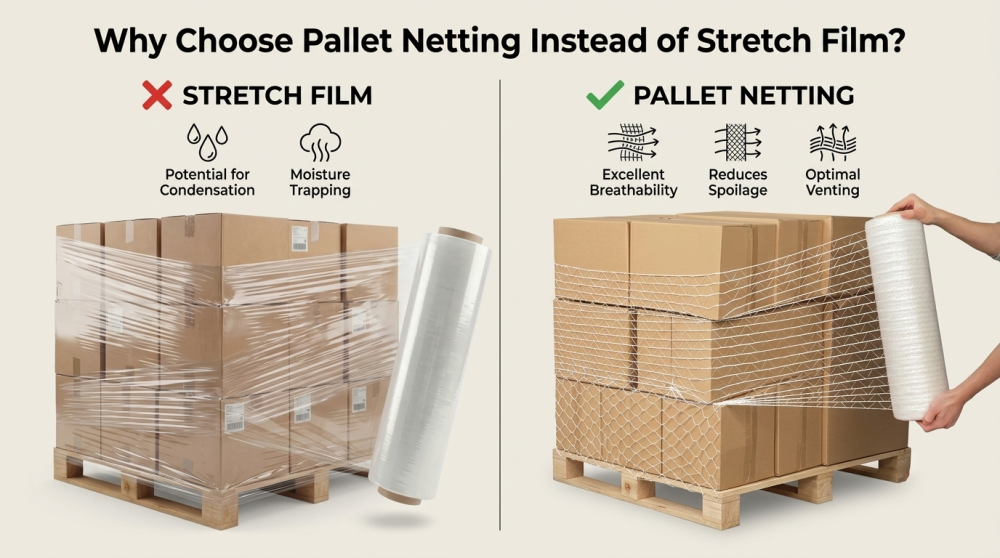
Why Choose Pallet Netting Instead of Stretch Film?
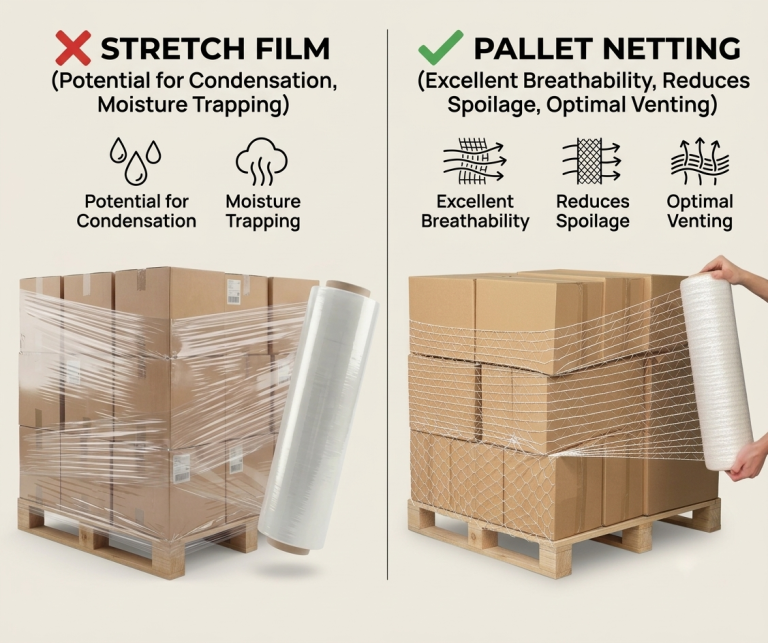
Both pallet netting and stretch film hold a palletized load together, but they solve the problem in opposite ways. Stretch film wraps a load in a continuous, sealed layer of plastic. Pallet netting wraps it in an open, breathable mesh. That single structural difference is what drives almost every other difference between them — airflow, cooling speed, condensation risk, weight, and cost.
Pallet Netting vs. Stretch Film: Quick Comparison
| Feature | Pallet Netting | Stretch Film |
|---|---|---|
| Airflow | Excellent | Poor |
| Cooling speed | Fast | Slow |
| Condensation | Low | High |
| Weight | Light | Heavy |
| Cost | Lower | Higher |
The sections below explain what’s actually driving each row of this table.
1. Airflow: Open Mesh vs. Sealed Film
Pallet netting is knitted into an open-grid structure, so the gaps between strands stay open even under tension — commercial pallet net wrap is generally cited at close to 100% air circulation through the load. Standard stretch film, by contrast, forms a continuous, largely unbroken layer once wrapped, which is exactly what makes it effective for dust and moisture exclusion — but poor for anything that needs to breathe.
This is why the packaging industry has developed vented or perforated stretch films with die-cut holes specifically to compensate for this weakness in standard film. Even vented film, however, is a modified version of a sealed material; pallet netting is open by design rather than by added perforation.
2. Cooling Speed: Why Netting Cools Faster
Palletized goods that leave a hot production line, a field, or a cold-storage tunnel need to reach ambient or target temperature as quickly as possible. Because pallet netting allows continuous airflow through the entire load rather than only through cut holes, heat exchange with the surrounding air happens faster and more evenly across the pallet. Knitted netting is generally considered the fastest-cooling wrap option in industrial packaging comparisons, ahead of both solid film and perforated film, precisely because the open structure offers no barrier to air movement at all.
Slower cooling under stretch film matters most for:
- Produce and cut flowers moving from field heat into cold storage
- Hot-filled containers and freshly molded plastic products
- Baked goods and other items releasing residual heat after production

3. Condensation: Where the Moisture Actually Goes
Condensation forms when warm, moist air inside a sealed wrap meets a cooler surface — the plastic film itself, or the goods as they cool — and has nowhere to escape. This is the core failure mode of solid stretch film for temperature-sensitive cargo: trapped humidity condenses on the inside of the film, drips back onto the product, and accelerates mold, spoilage, or corrosion depending on the goods.
Pallet netting avoids this because there’s no sealed cavity to trap moisture in the first place. Air — and the water vapor it carries — keeps moving through the mesh instead of collecting against a plastic surface. This is why fresh produce, nursery plants, and other perishable cargo are typically wrapped in netting rather than standard film for transport and storage.
4. Weight: Less Material for the Same Load
Pallet netting is manufactured in very light rolls — commonly around 8–9 grams per meter for standard elastic and non-elastic pallet net wrap — because the knitted mesh only needs enough HDPE strand to provide grip and tensile strength, not a full continuous surface. Stretch film, being a solid sheet, requires substantially more raw material (measured in microns of thickness, commonly 15–35 microns for hand film and higher gauges for machine film) to achieve comparable load-holding strength.
The practical result: pallet netting typically reduces packaging material volume by up to 45% compared to solid stretch film for equivalent coverage, which also means less packaging waste generated per pallet at the unwrapping stage.
5. Cost: Where the Savings Come From
Lower material weight per pallet is the main driver of pallet netting’s cost advantage — less HDPE per roll means more pallets wrapped per kilogram of raw material purchased. Netting rolls also typically require fewer wraps per load (2–3 passes is common for many applications) compared to the multiple overlapping layers standard stretch film needs to achieve similar containment force, which reduces labor time on manual lines and cycle time on automated ones.
Stretch film’s per-pallet cost tends to run higher in operations that require heavier gauges for stability, additional vented or perforated variants for produce, or top-sheet covering to fully protect the load — all of which pallet netting typically doesn’t need for equivalent breathable-load applications.
When Stretch Film Still Makes Sense
Pallet netting isn’t a universal replacement. Standard stretch film — or specialized ventilated film — remains the better choice when:
- The load must be fully sealed against dust, moisture, or tampering during transit
- Products are sensitive to airflow (e.g., certain chemicals, or goods requiring a controlled sealed atmosphere)
- The cargo is uniform, palletized in dense blocks with no need for visual inspection through the wrap
For everything else — fresh produce, plants, timber, food and beverage, building materials, and any load where breathability and load visibility both matter — pallet netting’s open structure generally outperforms solid film on the factors that affect product quality in transit.
FAQ
Q: Is pallet netting cheaper than stretch film?
A: Generally, yes. Pallet netting rolls use significantly less raw material per pallet — often up to 45% less volume than solid stretch film for equivalent coverage — and typically require fewer wraps per load, which lowers both material and labor cost.
Q: Why does pallet netting cool loads faster than stretch film?
A: Pallet netting is an open mesh, so air moves continuously through the entire load rather than being blocked by a sealed layer. This allows heat to dissipate faster and more evenly than through standard stretch film.
Q: Does pallet netting cause less condensation than stretch film?
A: Yes. Because the mesh structure allows air and moisture to keep moving through the load, there’s no sealed cavity for humidity to condense inside, unlike solid stretch film.
Q: Can pallet netting fully replace stretch film?
A: Not always. Stretch film is still preferred when a load needs to be fully sealed against dust or moisture, or when the cargo doesn’t require ventilation. Pallet netting is the better choice specifically when airflow, cooling, and load visibility matter.
Q: How much lighter is pallet netting compared to stretch film?
A: Standard pallet net wrap rolls run around 8–9 grams per meter, considerably lighter than the equivalent coverage from a solid stretch film roll, which needs more material thickness to achieve similar holding strength.
Changzhou Xinhui Netting Co., Ltd. manufactures pallet netting from 100% new HDPE, in elastic and non-elastic options, for manual and machine application. Request a free quote for custom widths, colors, and roll lengths.
📧 : sale1@xinhuibalenetwrap.com
🌐 : https://xinhuibalenetwrap.com
Request a Free Quote Today →
Supplying farms, co-operatives, and distributors across North America, Europe, Japan, Australia, and worldwide.


