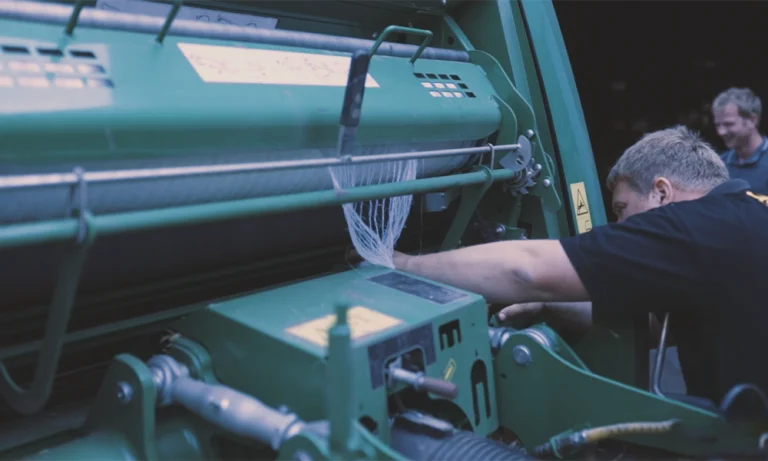
Modernizing the JD 535: Adding a Net Wrap Conversion Kit to a 30-Year-Old Legend

The John Deere 535 has earned its reputation the honest way — thousands are still baling hay and straw decades after they rolled off the line, and a well-maintained 535 remains a genuinely capable machine. But not every 535 left the factory the same way. Some were built or ordered with factory net wrap; a large number were sold as twine-only machines, and their owners are now asking the same question every season: is it worth converting to net wrap, or should the money go toward a different baler entirely?
This is one of those topics where the honest answer isn’t what most articles will tell you. Talk to owners who’ve actually priced out a conversion, and the consensus is consistent: retrofitting net wrap onto a twine-only 535 is technically possible, but for most owners, it’s not the bargain it initially looks like. This guide walks through what a conversion actually requires, what it realistically costs, and when it makes sense versus when your money is better spent elsewhere — plus what to look for in net wrap if your 535 already has (or will have) net wrap capability.
Two Different Versions of the JD 535
This is the detail that trips up a lot of buyers shopping used: the 535 wasn’t built as a single configuration. Deere offered it both with factory-installed net wrap and as a twine-only baler, and the two versions are mechanically quite different under the hood — not simply the same baler with an accessory bolted on.
| Configuration | What It Includes | What’s Missing on Twine-Only Models |
|---|---|---|
| Factory net wrap 535 | Net roll holder, cutting knife assembly, wrap-cycle monitor, wiring harness, net drive belt | N/A — fully equipped |
| Twine-only 535 | Twine tie arms, twine boxes, knotters | All net wrap hardware, monitor logic, and wiring |
If you’re shopping for a used 535 specifically because you want net wrap, confirming which version you’re looking at — before you buy, not after — saves you from exactly the situation this article is about.
What a Net Wrap Conversion Actually Requires
Adding net wrap capability to a twine-only 535 isn’t a bolt-on accessory — it’s closer to retrofitting a subsystem the baler was never wired or built for. Based on documented conversions and parts lists from owners who’ve done it, a full conversion typically involves:
- A net roll holder/mounting assembly
- A cutting knife assembly and its mounting hardware
- A wrap-cycle control monitor (or integration into the existing monitor, where possible)
- A full wiring harness to connect the monitor to the cutting and wrap mechanisms
- A net drive belt and associated pulleys
- Two net wrap rolls to complete the initial setup
Each of these components needs to be sourced — often from a donor parts baler, since factory conversion kits for a machine this old are not something most dealers stock — and correctly installed and calibrated to work with the 535’s existing chamber and monitor system.
The Real Cost Reality
This is where owner experience consistently diverges from what a “conversion kit” framing implies. Based on real-world reports from long-time 535 owners and mechanics, full conversions have historically run into the same range as — or more than — the resale value of the baler itself, once you account for sourcing components, monitor integration, and labor. Several owners who priced it out concluded that finding a used 535, or a comparable baler, that already came with factory net wrap was the more cost-effective path.
| Path | Typical Cost Consideration | Risk |
|---|---|---|
| Convert a twine-only 535 to net wrap | Comparable to or exceeding resale value of the baler | Sourcing hard-to-find components; dealer techs often unfamiliar with legacy net systems; no factory support |
| Buy a used 535 (or similar-era baler) already equipped with factory net wrap | Purchase price reflects a fully working net system | Standard used-equipment inspection risk, but no retrofit uncertainty |
| Buy a newer baler with net wrap standard | Higher upfront cost | Lower long-term maintenance risk, modern parts support |
None of this means conversion is never worth it — it depends entirely on your specific situation.

Hands-On: How to Decide If Conversion Is Worth It for Your 535
Step 1 — Get an actual resale value estimate for your baler as-is. Check recent sale prices for comparable twine-only 535s in your region before assuming the conversion will “add value” proportionate to its cost.
Step 2 — Price out real parts, not estimates. Contact salvage yards or parts suppliers for an actual quote on a net roll holder, cutting knife assembly, monitor, wiring harness, and drive belt — component costs for a 30-year-old machine vary a lot depending on availability.
Step 3 — Get a labor estimate from someone who has done this conversion before. A dealer or independent mechanic unfamiliar with legacy 535 net systems may take considerably longer — and charge more — than someone who’s done it before. Ask directly about their experience with this specific conversion.
Step 4 — Compare the total conversion cost against a used net-wrap-equipped 535 in similar mechanical condition. If a comparable machine with factory net wrap is available for a similar or lower total cost, that’s usually the better outcome unless you have a specific reason to keep this exact baler (sentimental value, known mechanical history, or parts already on hand).
Step 5 — Factor in your annual bale volume. For low-volume operations baling a modest number of bales per season, the cost-per-bale saved by switching from twine to net wrap may take many seasons to offset a conversion cost that exceeds the baler’s value — run this calculation with your own numbers before committing.
Step 6 — Check if you already have parts on hand. Owners with access to a donor parts baler, or who already own some of the required components, face a very different cost equation than someone sourcing everything from scratch — this is often the deciding factor in whether conversion actually makes sense.

If Your 535 Already Has Net Wrap — What to Check Before Buying Net Wrap Rolls
For 535 owners whose baler already has factory net wrap — or who’ve completed a conversion — the ongoing question shifts from “should I convert” to “what net wrap should I run.” Older net wrap systems can be less forgiving of poorly specified net than newer machines, since worn brake components and older monitor calibration leave less margin for error.
| Parameter | What to Confirm on an Older 535 | Why It Matters |
|---|---|---|
| Net brake condition | Inspect pads and springs — decades-old units often need replacement | Worn brakes combined with low-tensile net wrap compounds lazy wrap risk |
| Roll width | Confirm against your specific unit’s wrap holder — legacy units can vary by year and configuration | Wrong width causes uneven edge coverage or feed jams |
| Net weight (gauge) | 8–10 g/m² for hay/straw is a reasonable starting reference | Heavier gauge net wrap gives more margin for an older, less precisely tuned brake system |
| Material | 100% virgin HDPE with UV stabilizer | Consistent tensile strength matters more on machines with less adjustment range for compensating tension issues |
Reference specs based on standard bale net wrap manufacturing ranges (Xinhui Netting product data). Confirm exact roll width against your specific 535’s wrap holder and operator manual, since specifications can vary by production year.
Where Net Wrap Quality Comes From
Whether your 535 came with net wrap from the factory or you’ve decided a conversion makes sense for your situation, the net wrap itself still needs to compensate for a system that’s decades old and running with less precise tolerances than a new machine. Xinhui Netting manufactures bale net wrap using 100% virgin HDPE with UV stabilizers, in widths from 48″ to 67″ and weights from 7 to 12 g/m², with roll lengths up to 3000m, from a 25,000㎡ facility in Changzhou, China, supplying hay, straw, and silage operations across Europe, North America, South America, and Australia.
FAQ
Q: Did all John Deere 535 balers come with net wrap?
A: No — the 535 was offered both as a factory net wrap-equipped model and as a twine-only model, so it’s important to confirm which version you have (or are buying used) before assuming net wrap capability exists.
Q: Is it worth converting a twine-only JD 535 to net wrap?
A: For many owners, no — real-world conversion costs, including sourcing the net roll holder, cutting knife assembly, monitor, and wiring harness, have historically run comparable to or higher than the baler’s resale value, making a used net-wrap-equipped baler often the more cost-effective option.
Q: What parts are needed to convert a twine-only baler to net wrap?
A: A full conversion typically requires a net roll holder, cutting knife assembly, wrap-cycle monitor, wiring harness, net drive belt, and initial net wrap rolls, most of which need to be sourced from a donor parts baler for a machine this old.
Q: When does a net wrap conversion make more financial sense?
A: Conversion is more likely to make sense if you already have access to donor parts or some of the required components, have a high enough bale volume for the labor savings to offset the cost over a reasonable number of seasons, or have a specific reason to keep this exact baler rather than replace it.
Q: Does an older 535’s net wrap system need different net wrap than a newer baler?
A: Not fundamentally, but older units with worn net brake components have less margin for error, so a properly specified, consistent-tension net wrap matters more on an aging system than on a newer machine with tighter factory tolerances.
Q: How do I find the correct net wrap roll width for my JD 535?
A: Check your specific unit’s operator manual or wrap holder dimensions directly, since roll width specifications can vary across the 535’s production years and factory configurations.
Changzhou Xinhui Netting Co., Ltd. Professional Net Wrap Manufacturer | OEM & Private Label | Factory Direct Pricing
📧 : sale1@xinhuibalenetwrap.com
🌐 : https://xinhuibalenetwrap.com
Request a Free Quote Today →
Supplying farms, co-operatives, and distributors across North America, Europe, Japan, Australia, and worldwide.