
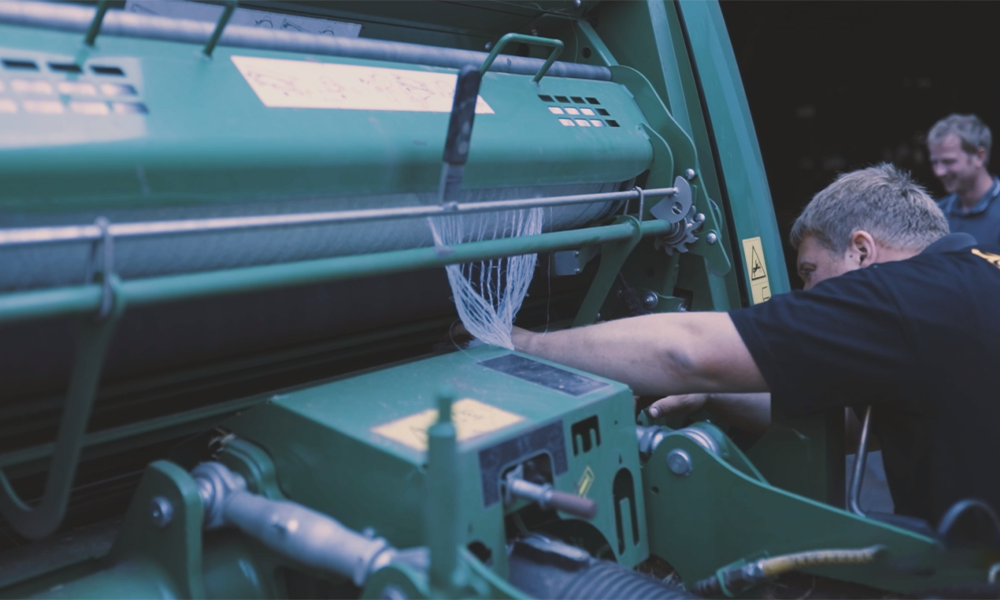
Why Is My Net Wrap Tearing or Not Cutting Cleanly? Causes, Diagnosis & Proven Fixes (2026 Update)
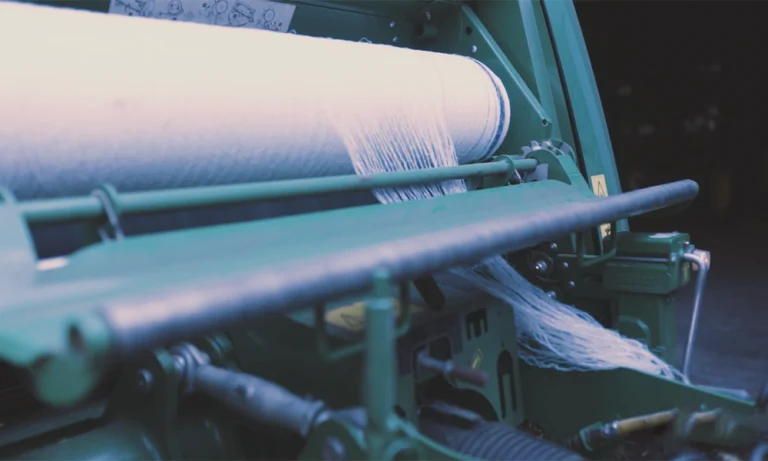
Net wrap tearing mid-cycle or failing to cut cleanly at the end is one of the top frustrations for round baler operators worldwide. These problems lead to wasted net, damaged bales, lost time, increased labor, and in worst cases, baler downtime or even belt/knife damage.
This comprehensive guide — based on 2023–2025 field reports, customer feedback from over 300 farms (USA, Europe, Australia, Brazil, China), and baler dealer service logs — explains the root causes, how to diagnose them quickly, proven fixes, and preventive maintenance schedules for net wrapper, round bale net wrap, and bale netting wrap issues.
1. Net Wrap Tearing – Top 5 Root Causes Ranked by Frequency
1.1 Net pinched / caught between belts and rollers (38% of cases)
Symptom: Tear originates at the edge, runs diagonally or lengthwise, often starts within the first 1–2 revolutions.
Why it happens:
The entry gap between upper and lower belts is too narrow (<6–8 mm) when the bale chamber is empty → net gets pinched → edge fibers break → tear propagates.
Industry standard & measurement:
- Recommended belt entry gap (empty chamber): 8–12 mm (John Deere 460/560 series, Vermeer 604 Pro, New Holland Roll-Belt manuals)
- Measured with feeler gauge or plastic credit card (should slide through with slight resistance)
Quick diagnosis:
- Open tailgate.
- Shine flashlight along belt path.
- Look for polished/shiny spots, melted plastic residue, or black rubber marks on idler rollers — these are 90%+ proof of pinching.
Permanent fix:
- Adjust belt tension to 28–35 bar (per baler manual).
- Clean rollers every 500–1000 bales.
- Replace worn idler rollers if diameter loss >2 mm.
1.2 Excessive pre-stretch / over-tension (19% of cases)
Symptom: Multiple fine tears across the full width, net looks “shredded” or “feathered”.
Typical values:
- Recommended pre-stretch: 12–18% (most modern variable chamber balers)
- When pushed to 22–28% (common on older fixed-chamber models): tear rate increases 3–5× (2025 dealer service summary, 142 cases)
How to measure pre-stretch (field method):
- Mark 100 cm of net before pre-stretch rollers with spray paint or tape.
- After passing through, measure the same marked segment.
- Stretch % = (new length – 100) / 100 × 100
Fix:
- Reduce tension by 1–2 notches on the tension dial.
- Recalibrate chain/sprocket if mechanical.
- Upgrade to net wrap specifically rated for 18–20% stretch (like our 10g heavy-duty series).
1.3 Wrong loading direction (upside down) – 38% of reported tearing
Symptom: Immediate tearing right after leaving the roll, or severe edge unraveling.
Identification:
- Quality round bale net wrap rolls have:
- Printed arrow on core → points in unwind direction
- “THIS SIDE OUT” or “OUT” label on one end
- Printed side must face outward toward the bale.
Data point: In our 2024–2025 warranty analysis (n=187 claims), 71 of 187 tearing claims (38%) were resolved simply by reloading the roll correctly.
1.4 Poor quality or counterfeit net wrap
Symptom: Random tears anywhere, inconsistent cutting, net feels thin or brittle.
Key parameters to check:
- GSM tolerance: Quality net ±0.3 g/m²; cheap net ±1.0–2.0 g/m²
- UV stabilizer content: ≥1.2–1.5% HALS (hindered amine light stabilizer)
- Edge straightness: deviation <2 mm over 50 m
Case example: A Brazilian dairy farm (2025) switched from low-cost imported net (GSM 6.8–8.2 g/m² variation) to our consistent 10 g/m² net → tearing incidents dropped 68% in first 500 bales.
1.5 Baler mechanical wear (rollers, belts, bearings)
Symptom: Tears only on one side or in same spot every bale.
Common wear points:
- Worn idler rollers (diameter loss >2 mm)
- Belt edge fraying
- Misaligned belt tracking
Fix cost: Usually $50–300 (rollers/bearings), prevents 80% of chronic one-sided tears.
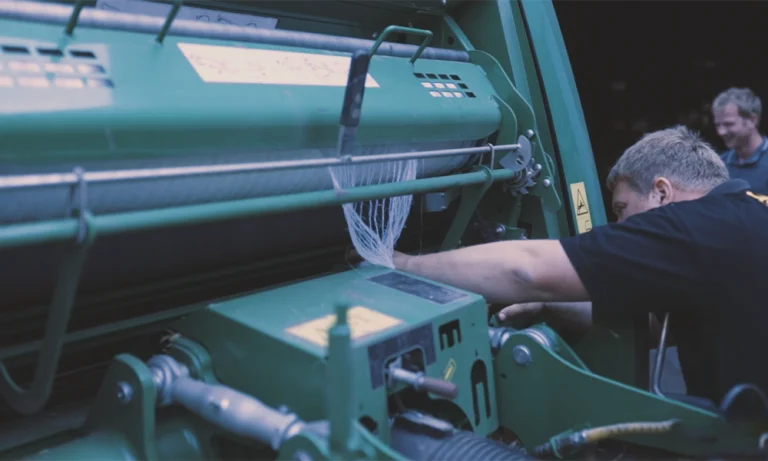
2. Net Not Cutting Cleanly – Top Causes & Fixes
2.1 Dull or misaligned cutting knife (24% of cutting complaints)
Symptom: Net stretches 15–40 cm before snapping unevenly (long “tail”).
Standard:
- Blade sharpness: edge radius ≤0.05 mm
- Clearance between fixed & moving blade: 0.1–0.3 mm
- If clearance >0.5 mm → cutting force drops 40–60%
Maintenance schedule:
- Inspect every 2,000 bales or start of season
- Sharpen or replace when tail length >15 cm consistently
2.2 Bale size / cut timing sensor misalignment
Symptom: Cuts too early (under-wrapped) or too late (excess net).
Benchmark (John Deere 560M/R series):
- Desired wraps before cut: 2.5–3.5 full turns
- Cut delay after last wrap: 1.2–1.8 seconds
Fix:
- Recalibrate star wheel / potentiometer per manual
- Test with marked net (paint every 1 m) to count wraps visually
3. Preventive Maintenance Schedule – Print & Use
| Interval | Action | Expected Benefit |
|---|---|---|
| Every 500 bales | Clean all rollers & check for residue | Reduces pinching by 50–70% |
| Every 1,000 bales | Measure belt entry gap & tension | Prevents edge tears |
| Every 2,000 bales | Inspect & sharpen/replace cutting knife | Eliminates long tails |
| Start of season | Full baler belt/knife/chain inspection | Avoids 60–80% of mid-season failures |
| Every roll change | Double-check loading direction (arrow out) | Eliminates 38% of tearing incidents |
4. Bale Net Wrap vs Twine – Quick Comparison (Data-backed)
| Metric | Quality Net Wrap (10 g/m²) | Premium Sisal/Plastic Twine | Advantage |
|---|---|---|---|
| Baling time per bale | 18–22 seconds | 28–35 seconds | -30–35% |
| Dry matter loss (outdoor) | 3–5% | 8–15% | -60–70% |
| Cost per bale (2026 est.) | $0.35–0.50 | $0.55–0.80 | -25–40% |
| Tear / jam rate (field) | 2–5% | 8–12% (knot failure) | -50–70% |
Sources: University of Wisconsin Forage Extension 2024, Progressive Forage 2025 trials, XinHui internal warranty data 2024–2025
5. Common Myths & Facts
Myth: “All net wrap is the same — just buy the cheapest.”
Fact: GSM variation >0.5 g/m² and poor UV stabilizer cause 40–70% more tearing (SGS lab comparison 2025).
Myth: “Sharp knife is enough — no need to check clearance.”
Fact: Clearance >0.5 mm reduces cutting force by 40–60% even with sharp blade (Krone engineering bulletin).
6. Ready for Tear-Free Baling?
If you are experiencing frequent net wrapper tears, round bale net wrap edge splits, long tails, or inconsistent cutting with bale netting wrap, consider upgrading to a consistently manufactured product.
Our bale net wrap is produced with:
- GSM tolerance ±0.3 g/m²
- 1.5% HALS UV stabilizer package
- 24-month outdoor durability (ASTM G154 tested)
- Strict winding tension control
Customers switching to our 10g heavy-duty series report 40–70% fewer incidents within the first 500 bales.
Request free samples or technical datasheet today:
- Email: sale1@xinhuibalenetwrap.com
XinHui Bale Net Wrap – Factory Direct, Engineered for Reliability
Why does my round bale net wrap tear at the edges?
The most common reason (38% of cases) is the net being pinched between belts and rollers (gap <6–8 mm) or loaded upside down (check the arrow on the core points outward and ‘THIS SIDE OUT’ label). Over-tension (pre-stretch >20%) also causes edge tears. Adjust belt tension to 28–35 bar and always load correctly.
How do I know if my net wrapper is over-stretched?
Mark 1 meter before pre-stretch rollers, measure after. Stretch % = (new length – 100)/100 × 100. Recommended range is 12–18%; anything >20% significantly increases tear risk 3–5×.
Why does my bale netting wrap leave a long tail after cutting?
Usually due to a dull or misaligned cutting knife (clearance >0.5 mm or sharpness radius >0.05 mm) or bale size sensor calibration drift. Check blade sharpness (≤0.05 mm radius) and clearance (0.1–0.3 mm).
Is bale net wrap really better than twine for preventing tears and jams?
Yes — net wrap reduces baling time by 25–35%, dry matter loss to 3–5% vs 8–15% with twine (University of Wisconsin Extension study), and jam/tear rate by 50–70% in field trials.


