What Size Twine Do I Need for a Square Baler?
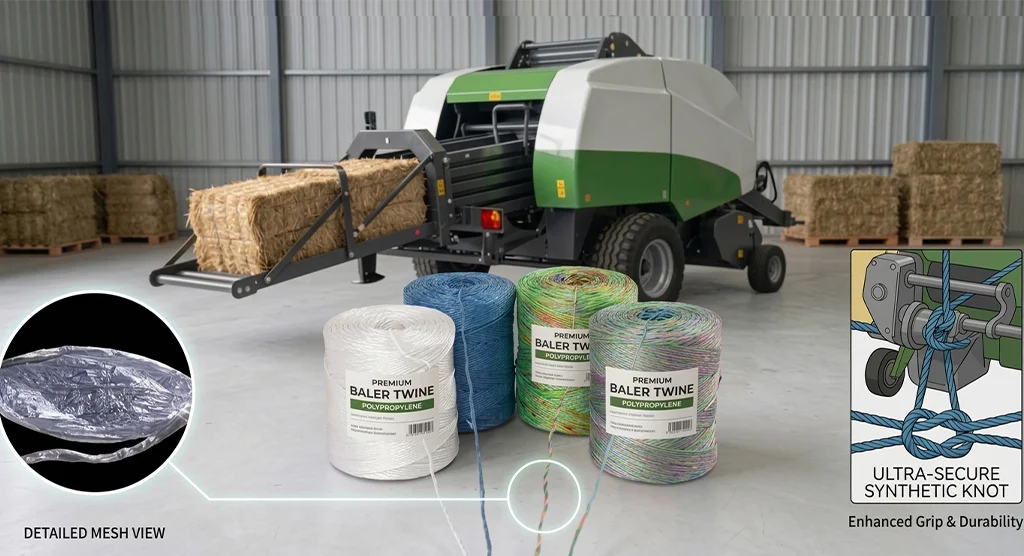
Unlike round balers, square baler twine is rated by knot strength — not tensile strength — because square balers tie an actual knot to close each bale. Choosing the wrong size means broken knots, bales falling apart on the wagon, or twine that jams your knotter. This guide covers the real industry-standard sizes for both small and large square balers, how knot strength ratings work, and exactly how much twine you’ll need per bale.
Quick Answer: Standard Square Baler Twine Sizes
Square baler twine comes in two very different categories depending on bale size:
- Small square baler twine: Sold in long rolls of 7,200 to 9,600 feet, with knot strength ratings typically between 130 and 210 lbs.
- Large (big) square baler twine: Sold in much shorter rolls of 3,500 to 4,850 feet, with knot strength ratings of 350 to 700+ lbs to handle far heavier, denser bales.
The shorter the roll, the thicker and stronger the twine — because big square bales weigh a ton or more and put enormous strain on the knot.
Small Square Baler Twine Sizes Explained
For small square bales (the traditional rectangular bales you can lift by hand), here’s what’s actually on suppliers’ shelves:
| Roll Length | Knot Strength | Avg. Bale Weight | Bales Tied per Roll | |
|---|---|---|---|---|
| 9,000 ft | 130 lb | ~70 lbs | ~500 bales | |
| 7,200 ft | 170–190 lb | ~100 lbs | ~400 bales | |
| 9,600 ft | 170–210 lb | ~100 lbs | ~530 bales |
A common rule of thumb from experienced hay producers: budget roughly 18 feet of twine per small square bale (two strands included). That means a pair of 9,000-foot rolls will comfortably tie about 1,000 bales — a handy number when planning baler twine for sale purchases ahead of hay season.
If you’re baling lighter, drier hay, a 130-knot hay baler twine is usually sufficient. For denser, damper bales — or if you’ve had strands snap mid-run — stepping up to a 190- or 210-knot square baler twine gives you more margin.
Big (Large) Square Baler Twine Sizes Explained
Large square baler twine is a completely different product from small square twine. Because big square bales can weigh 1,500–2,000+ lbs, the twine needs dramatically more knot strength packed into a much shorter roll:
| Roll Length | Knot Strength | Avg. Bale Weight | Bales Tied per Roll | |
|---|---|---|---|---|
| 4,850 ft | 350 lb | ~2,000 lbs | ~34 bales | |
| 4,000 ft | 350–550 lb | ~2,000 lbs | ~28 bales | |
| 3,500 ft | 700 lb (High Density) | ~2,000 lbs | ~25 bales |
If you’re running a large square baler on heavy alfalfa, cornstalks, or straw, don’t be tempted to save money with a lower knot-strength twine — strongest baler twine for big square balers typically means 500–700 lb High Density (HD) product, especially for bales headed for export or long-haul trucking where extra handling stress is common.
Knot Strength: Why It’s the Right Metric for Square Balers
Square balers physically tie a knot to close each bale, so the twine’s knot strength — how much pulling force the tied knot can withstand before failing — is the number that matters most. This is different from round balers, which wrap and cut twine without tying a knot and are instead rated by tensile strength (the raw breaking force of the strand itself).
- 130–210 lb knot strength: Standard range for small square bales
- 350–700+ lb knot strength: Required range for large square bales
If you switch from a small square baler to a large square baler (or vice versa), you cannot simply reuse the same twine — the knot strength and roll thickness are engineered for very different bale weights and knotter mechanisms.
How Much Twine Do You Need for Square Bales?
For small square baler twine, plan on roughly 18 feet per bale (both strands combined), meaning:
- 1,000 small bales ≈ 18,000 feet ≈ two 9,000-foot rolls
- 5,000 small bales ≈ 90,000 feet ≈ ten 9,000-foot rolls (or roughly 9–10 rolls of 9,600 ft)
For large square baler twine, usage scales with bale size and knot count per bale — a 4,000-foot roll typically ties around 28 large bales, so a season producing 500 large square bales would require roughly 18 rolls at that footage. Always check your specific baler’s knotter settings, since strand count and tie length vary by brand and model.
Sisal Twine vs. Polypropylene Twine for Square Balers
Both materials are available across small and large square baler twine sizes:
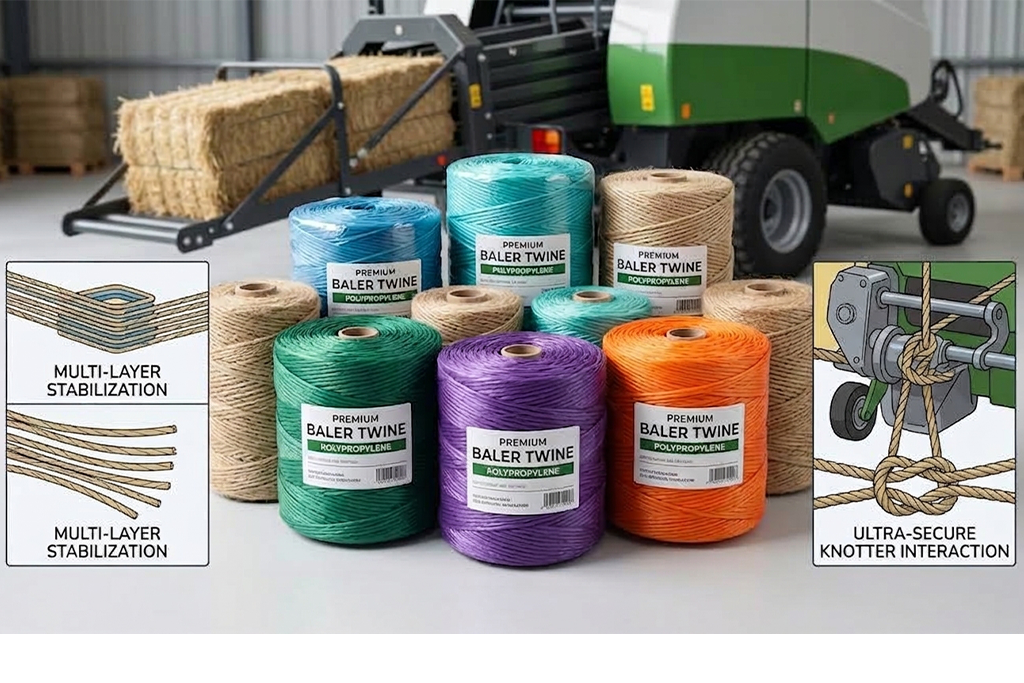
- Sisal baler twine: A natural-fiber option favored for its biodegradability — a plus if bales are fed to livestock with twine occasionally left on. Sisal square baler twine tends to be slightly less UV-resistant than plastic.
- Polypropylene (poly) baler twine: More resistant to moisture, UV exposure, and rot, making it a strong choice for bales stored outdoors for extended periods. Polypropylene baling twine is also generally more consistent in diameter, which can reduce knotter jams.
If your bales are headed for retail sale, landscaping, or long-term storage, poly twine’s durability is usually worth the switch. If biodegradability and livestock safety are priorities, sisal remains a solid, traditional choice.
How to Choose the Right Twine Size for Your Square Baler
- Match to your baler type: Small square balers need 7,200–9,600 ft rolls; large square balers need 3,500–4,850 ft rolls. These are not interchangeable.
- Match knot strength to bale density: Denser or damper hay needs higher knot strength (190–210 lb for small squares; 500–700 lb HD for large squares).
- Consider storage conditions: Outdoor storage favors polypropylene; indoor/livestock feeding favors sisal.
- Check your knotter’s tension settings: Twine that’s too thick or too thin for your knotter’s calibration will cause missed ties or jams — consult your operator’s manual before switching brands or sizes.
Where to Buy Square Baler Twine
Square baler twine is widely stocked at Tractor Supply, Rural King, and dedicated agricultural suppliers, both in-store and online in bulk. When comparing square bale twine options, look at:
- Price per foot rather than price per roll
- Knot strength rating appropriate to your bale size
- Roll length matched to your baler type (small vs. large square)
- Sisal vs. polypropylene based on your storage and feeding needs
Buying twine in bulk ahead of hay season typically brings meaningful per-roll savings, especially for operations running both small and large square balers.
Tips for Getting the Most Out of Your Square Baler Twine
- Store rolls indoors, away from moisture and direct sun, to preserve knot strength — this matters even more for sisal than poly
- Keep separate, clearly labeled stock for small vs. large square baler twine to avoid grabbing the wrong roll mid-season
- Test a new knot-strength rating on a few bales before committing a full field run, especially when switching suppliers
- Keep spare rolls on hand — running out mid-field costs more time than the twine itself
Frequently Asked Questions
What size twine do I need for a small square baler?
Small square balers typically use twine in 7,200 to 9,600-foot rolls with knot strength ratings between 130 and 210 lbs, depending on bale density and hay type.
What size twine do I need for a large square baler?
Large square balers require much shorter, thicker rolls — typically 3,500 to 4,850 feet — with knot strength ratings from 350 lbs up to 700 lbs for high-density applications.
Is square baler twine measured in knot strength or tensile strength?
Square baler twine is measured in knot strength, since square balers tie an actual knot to close each bale. This differs from round baler twine, which is rated by tensile strength.
How many small square bales can one roll of twine tie?
A 9,000-foot roll typically ties about 500 small square bales, while a 9,600-foot roll can tie roughly 530 bales, depending on bale size and strand count.
Can I use the same twine for a small and a large square baler?
No. Small square baler twine and large square baler twine differ significantly in roll length and knot strength — using the wrong size can cause broken knots or knotter jams.
Is sisal or polypropylene twine better for square balers?
Sisal twine is biodegradable and a safer option if livestock might consume leftover strands, while polypropylene twine offers better resistance to moisture and UV exposure, making it a better fit for long-term outdoor storage.
Changzhou Xinhui Netting Co., Ltd. Professional baler twine suppliers | OEM & Private Label | Factory Direct Pricing
📧 : sale1@xinhuibalenetwrap.com
🌐 : https://xinhuibalenetwrap.com
Request a Free Quote Today →
Supplying farms, co-operatives, and distributors across North America, Europe, Japan, Australia, and worldwide.