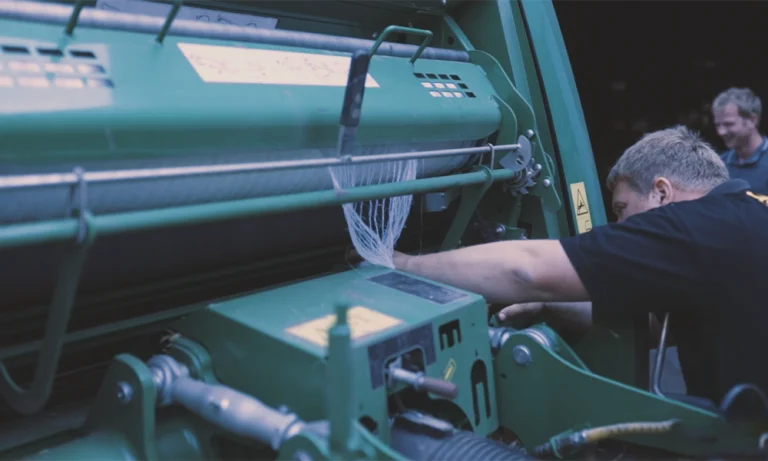
The “Backward” Spiral Roller: A Vermeer 605N Owner’s Checklist for Net Feeding Issues

Introduction: When Your Vermeer 605N Stops Wrapping Right
There are few things more frustrating in a baling operation than a net wrap feeding problem mid-field. The bale chamber is full, the crop is ready, and the net wrap system refuses to cooperate. On the Vermeer 605N round baler, one of the most frequently reported causes of net feeding failure is something that sounds almost too simple to be true: a spiral roller installed backward.
If you’re experiencing net wrap that won’t feed, feeds inconsistently, wraps unevenly, or jams repeatedly on your Vermeer 605N, this checklist is for you. We walk through the backward spiral roller issue in detail, cover every other common cause of net feeding problems on the 605N, and give you a systematic diagnostic process to work through before calling your dealer.
We also address one factor that many operators overlook entirely: the role of net wrap quality itself in feeding performance. A well-maintained baler can still experience feeding problems if the net wrap roll has inconsistent tension, incorrect width, or substandard material — and knowing how to identify this is part of any complete diagnostic checklist.
Understanding the Vermeer 605N Net Wrap System
Before working through the checklist, it helps to understand how the Vermeer 605N net wrap system is designed to work.
The 605N uses a net wrap feeding system that draws net wrap from the roll, feeds it through a series of rollers and guides, and delivers it into the bale chamber at the correct moment in the baling cycle. The key components involved in this process are:
- The net wrap roll and mounting system — holds the roll and controls unwinding tension
- The spiral roller (spreader roller) — a helically grooved roller that spreads the net wrap to full width as it feeds into the chamber
- The feed rollers — drive the net wrap forward into the bale chamber
- The net wrap knife — cuts the net wrap at the end of the wrapping cycle
- The net wrap guides and tensioners — maintain correct alignment and tension throughout the feed path
- The net wrap sensor — detects net wrap presence and signals the system controller
When all components are correctly installed, adjusted, and functioning, the 605N net wrap system feeds reliably and consistently. When any single component is out of specification — including the net wrap roll itself — feeding problems follow.
The Backward Spiral Roller: What It Is and Why It Matters
What Is the Spiral Roller?
The spiral roller (also called the spreader roller or helical roller) is one of the most important — and most misunderstood — components in the Vermeer 605N net wrap system. It is a cylindrical roller with a helical (spiral) groove machined into its surface. As the net wrap passes over this roller, the spiral groove pushes the net wrap laterally outward from the center toward both edges, ensuring the net wrap is spread to its full width before entering the bale chamber.
Full-width feeding is critical. If the net wrap enters the chamber narrower than its full width, the bale ends will be insufficiently covered — leaving exposed crop that is vulnerable to weather, leading to spoilage and nutrient loss during storage.
What Happens When It’s Installed Backward?
The spiral groove on the 605N’s spreader roller is directional — it is designed to spread the net wrap outward (from center to edges) when the roller turns in its correct operational direction. When the roller is installed 180 degrees backward — rotated end-for-end from its correct orientation — the spiral groove works in reverse: instead of spreading the net wrap outward, it gathers the net wrap inward toward the center.
The results are predictable and problematic:
- Net wrap bunches in the center rather than spreading to full width
- Bale ends are left uncovered or poorly covered
- Net wrap folds and jams as it tries to enter the chamber while gathered
- Wrapping cycle fails to complete as the net wrap system detects a feed error
- Bale quality is inconsistent with uneven coverage across the bale surface
How Does It Get Installed Backward?
The backward spiral roller problem most commonly occurs after:
- Routine maintenance — when the spiral roller is removed for cleaning or inspection and reinstalled incorrectly
- Roller replacement — when a worn roller is swapped and the new one is installed without reference to the correct orientation
- Unfamiliar technician work — when someone unfamiliar with the 605N’s specific net wrap system installs the roller without checking the operator’s manual
The roller itself is often symmetrical in appearance — it looks the same from both ends — which makes it easy to install in the wrong orientation without realizing it. The spiral groove direction is the only visible indicator of correct orientation, and it requires careful inspection to identify.
How to Check the Spiral Roller Orientation
- Locate the spiral roller in the net wrap feed path — it sits between the net wrap roll mounting and the feed rollers
- Identify the spiral groove direction — stand at one end of the roller and trace the groove direction
- Check against the operator’s manual — Vermeer’s 605N operator manual specifies the correct groove orientation for the spiral roller. The groove should spread net wrap outward from center to edges when the roller turns in its operational direction
- Rotate the roller by hand while holding a piece of net wrap lightly against it — correctly installed, you should feel the net wrap being pushed toward both edges; incorrectly installed, it will be pulled toward the center
- If backward, remove and reinstall in the correct orientation — this typically requires removing a retaining clip or bolt at each end of the roller shaft
Vermeer 605N Net Feeding Issues — Complete Diagnostic Checklist
Work through this checklist systematically. Start at the net wrap roll and work forward through the feed path to the bale chamber.
Section 1: Net Wrap Roll and Mounting
1.1 — Is the net wrap roll the correct width? The Vermeer 605N requires net wrap in the correct width for its bale chamber. Confirm your net wrap roll matches the specified width for your machine. Running a narrower roll than specified will result in poor bale end coverage regardless of how well the feeding system is functioning.
1.2 — Is the net wrap roll mounted correctly? The roll should be seated firmly and squarely in the mounting cradle with the net wrap unwinding in the correct direction. Check your operator’s manual for the correct unwind direction — feeding from the top or bottom of the roll varies by system design.
1.3 — Is the roll free to rotate? Spin the roll by hand. It should rotate freely without resistance. Excessive friction from a damaged cradle, a bent spindle, or debris around the mounting area will cause uneven net wrap tension and inconsistent feeding.
1.4 — Is the roll core damaged or deformed? A crushed, cracked, or out-of-round roll core causes uneven unwinding tension and can lead to net wrap surging or jamming during the feed cycle. Inspect the core condition before mounting.
1.5 — Is the net wrap roll of consistent quality? Inconsistent roll winding — layers wound at uneven tension during manufacturing — causes the net wrap to unwind in surges rather than smoothly. This is a net wrap quality issue, not a baler issue. See Section 6 for more detail on net wrap quality and its effect on feeding.
Section 2: The Spiral Roller (Spreader Roller)
2.1 — Is the spiral roller installed in the correct orientation? This is the most common single cause of net feeding failure on the 605N. As described above, confirm the spiral groove direction is spreading net wrap outward from center to edges. If in doubt, consult the operator’s manual or contact your Vermeer dealer.
2.2 — Is the spiral roller surface clean and undamaged? Crop debris, twine fragments, and net wrap residue can pack into the spiral groove and reduce its spreading effectiveness. Clean the groove thoroughly with a stiff brush. Check for wear or damage to the groove surface — a worn groove will not spread net wrap effectively even when correctly installed.
2.3 — Does the spiral roller spin freely? The roller should rotate freely on its shaft without binding. Check the bearings at each end — worn or seized bearings will prevent the roller from turning, causing net wrap to drag rather than feed smoothly.
2.4 — Are the roller shaft retaining clips or bolts secure? A loose spiral roller can shift laterally during operation, reducing its spreading effectiveness and potentially allowing net wrap to track off-center.
Section 3: Feed Rollers
3.1 — Are the feed rollers clean and free of debris? Net wrap residue, crop material, and twine can wrap around feed rollers and reduce their grip on the net wrap. Clean all feed rollers thoroughly and confirm they are free of accumulated material.
3.2 — Do the feed rollers grip the net wrap correctly? With the system in the feed position, check that the feed rollers are applying even pressure across the full width of the net wrap. Uneven roller pressure causes the net wrap to track to one side and can lead to mis-feeds or jams.
3.3 — Is the feed roller drive functioning correctly? Check that the drive mechanism — whether hydraulic, mechanical, or electric depending on your 605N specification — is engaging and driving the feed rollers at the correct speed. A feed roller that turns too slowly will cause the net wrap to lag; one that turns too fast may cause it to bunch.
3.4 — Are feed roller bearings in good condition? Worn bearings cause rollers to wobble or bind, leading to uneven net wrap tension during feeding. Inspect and replace worn bearings as part of regular maintenance.
Section 4: Net Wrap Guides, Tensioners, and Path
4.1 — Are all net wrap guides correctly positioned? Net wrap guides direct the net wrap along the feed path and prevent it from tracking off-center. Check that all guides are in their correct positions — a bent, missing, or incorrectly adjusted guide is a common cause of net wrap misalignment.
4.2 — Is net wrap tension correct throughout the feed path? Too much tension causes the net wrap to stretch or break during feeding. Too little tension allows it to sag and fold, leading to mis-feeds. Check and adjust tensioners according to the specifications in the 605N operator’s manual.
4.3 — Is the net wrap path clear of obstructions? Walk the full net wrap path from roll to chamber and check for any obstruction — crop debris, twine fragments, damaged sheet metal, or foreign objects — that could cause the net wrap to snag or jam during feeding.
4.4 — Are there any sharp edges in the feed path? Damaged or worn sheet metal edges along the net wrap feed path can snag or cut the net wrap during feeding. Check the entire path for burrs, sharp bends, or damaged metal and repair or smooth any issues found.
Section 5: Net Wrap Knife
5.1 — Is the net wrap knife sharp and correctly adjusted? A dull or misadjusted knife will not cut the net wrap cleanly at the end of the wrapping cycle, causing the net wrap to tear irregularly or fail to cut at all. Check knife sharpness and adjustment according to the operator’s manual specification.
5.2 — Is the knife actuating correctly? Confirm that the knife mechanism is engaging fully and at the correct point in the wrapping cycle. A knife that actuates too early, too late, or incompletely will cause cut failures or timing problems in the wrap cycle.
5.3 — Is there net wrap residue built up around the knife area? Net wrap fragments and crop material can accumulate around the knife, interfering with its action. Clean the knife area thoroughly and inspect for material buildup that could prevent clean operation.
Section 6: Net Wrap Sensor
6.1 — Is the net wrap sensor clean and unobstructed? The net wrap sensor detects whether net wrap is present in the feed path and communicates with the baler’s control system. Crop dust, debris, or net wrap residue on the sensor can cause false readings — telling the controller that net wrap is not present when it is, or vice versa.
6.2 — Is the sensor correctly positioned? A sensor that has shifted out of its correct position may not detect net wrap reliably. Check the sensor mounting and confirm it is positioned as specified in the operator’s manual.
6.3 — Is the sensor functioning correctly? If cleaning and repositioning do not resolve sensor-related issues, test the sensor’s electrical function. Faulty sensors should be replaced — a malfunctioning net wrap sensor can cause confusing and intermittent feeding problems that are difficult to diagnose without addressing the sensor directly.


Section 7: Net Wrap Quality — The Often-Overlooked Factor
This is the section that many operators skip — but it’s one of the most important. Even a perfectly maintained Vermeer 605N with correctly installed components can experience feeding problems if the net wrap itself is substandard.
7.1 — Is the net wrap roll wound consistently? Professionally manufactured net wrap is wound at consistent tension throughout the roll, ensuring smooth, even unwinding during the feed cycle. Net wrap manufactured to lower quality standards may have inconsistent winding tension — tight in some sections, loose in others — causing the net wrap to surge during feeding and leading to mis-feeds or jams.
7.2 — Is the net wrap width correct and consistent? Net wrap that is narrower than specified, or that varies in width across the roll, will not feed correctly through the 605N’s feed system. Width consistency is a manufacturing quality issue — confirm your net wrap supplier produces to consistent dimensional tolerances.
7.3 — Is the net wrap material consistent in tensile strength? Net wrap produced from 100% new (virgin) HDPE with consistent material properties maintains uniform tensile strength across the full roll. Net wrap produced from inconsistent raw material may have weak points that cause breakage during the feeding or wrapping cycle.
7.4 — Is the net wrap surface clean and free of manufacturing defects? Contamination, surface irregularities, or manufacturing defects in the net wrap material can cause it to stick to rollers, jam in guides, or feed unevenly. Inspect a length of net wrap from the roll before beginning each baling session.
7.5 — Has your net wrap supplier changed recently? If net feeding problems began after switching to a new net wrap brand or supplier, the new product may be the cause. Feeding issues that correlate with a change in net wrap source are strong evidence of a net wrap quality issue rather than a baler problem.
Summary Checklist — Quick Reference
| Section | Check Item | Status |
|---|---|---|
| Roll & Mounting | Correct width for 605N | ☐ |
| Roll mounted correctly, unwind direction confirmed | ☐ | |
| Roll rotates freely | ☐ | |
| Roll core undamaged | ☐ | |
| Net wrap quality consistent | ☐ | |
| Spiral Roller | Installed in correct orientation (not backward) | ☐ |
| Groove clean and undamaged | ☐ | |
| Roller spins freely on shaft | ☐ | |
| Retaining clips / bolts secure | ☐ | |
| Feed Rollers | Clean and free of debris | ☐ |
| Even pressure across full net wrap width | ☐ | |
| Drive functioning correctly | ☐ | |
| Bearings in good condition | ☐ | |
| Guides & Tensioners | All guides correctly positioned | ☐ |
| Net wrap tension correct throughout path | ☐ | |
| Feed path clear of obstructions | ☐ | |
| No sharp edges in feed path | ☐ | |
| Net Wrap Knife | Knife sharp and correctly adjusted | ☐ |
| Knife actuating correctly | ☐ | |
| Knife area clean and clear | ☐ | |
| Net Wrap Sensor | Sensor clean and unobstructed | ☐ |
| Sensor correctly positioned | ☐ | |
| Sensor functioning correctly | ☐ | |
| Net Wrap Quality | Roll wound consistently | ☐ |
| Width correct and consistent | ☐ | |
| Material consistent in tensile strength | ☐ | |
| No surface defects or contamination | ☐ |
When to Call Your Vermeer Dealer
This checklist covers the most common causes of net feeding problems on the Vermeer 605N and can be worked through by an experienced operator without specialist tools. However, there are situations where dealer involvement is the right call:
- The spiral roller orientation has been confirmed correct, all other checklist items have been addressed, and the feeding problem persists
- There is visible damage to the net wrap drive system, feed roller mechanism, or knife actuator that requires parts replacement
- Electronic or control system faults are indicated on the baler’s display — sensor or controller issues may require diagnostic equipment available only at the dealer
- The feeding problem is intermittent and cannot be reproduced reliably during a static inspection
In these cases, document as much as you can about when and how the problem occurs — frequency, whether it happens at the start of the wrap cycle or mid-cycle, whether it affects the full width of the net wrap or just one side — and share this information with your dealer to assist diagnosis.
The Net Wrap Quality Connection: Why Your Supplier Matters
As noted in Section 7, net wrap quality is a genuine contributor to feeding performance — and one that is frequently overlooked when diagnosing baler problems. A correctly functioning Vermeer 605N with a correctly installed spiral roller can still experience feeding difficulties if the net wrap roll itself is inconsistently wound, dimensionally variable, or manufactured from non-uniform raw material.
The foundation of reliable net wrap feeding performance is a product manufactured from 100% new (virgin) HDPE with consistent raw material properties, wound at uniform tension throughout the roll, and produced to consistent dimensional tolerances for width and thickness.
Changzhou Xinhui Netting Co., Ltd. is a professional net wrap manufacturer supplying agricultural markets worldwide. Our net wrap is produced from 100% new HDPE with UV stabilizers, wound to consistent roll tension, and manufactured to precise dimensional specifications — delivering the feeding consistency that a well-maintained baler like the Vermeer 605N is designed to work with.
If net feeding problems on your 605N correlate with a recent change in net wrap supplier, or if you want to ensure your net wrap is not a contributing factor to feeding issues, contact us for specifications and pricing on factory-direct supply.
Xinhui Netting — Net Wrap Compatible with Vermeer 605N
Changzhou Xinhui Netting Co., Ltd. produces net wrap in the standard North American widths compatible with the Vermeer 605N and other major round baler brands — supplied factory-direct to farms and distributors worldwide.
Vermeer 605N Compatible Specifications
| Width | Length | Net Weight Options |
|---|---|---|
| 48″ (122 cm) | 9,840 ft (3,000 m) | 7 / 8 / 9 / 10 / 12 g/m² |
| 51″ (130 cm) | 9,840 ft (3,000 m) | 7 / 8 / 9 / 10 / 12 g/m² |
Full Product Range
| Parameter | Options |
|---|---|
| Width | 48″, 51″, 64″, 67″ (NA) / 1.23 m, 1.25 m, 1.30 m (EU) / custom |
| Length | 1,000 m / 2,000 m / 3,000 m / 3,600 m / 4,000 m / 5,000 m — or custom |
| Net Weight | 7 / 8 / 9 / 10 / 12 g/m² |
| Material | 100% new HDPE + UV stabilized |
| Color | White, Green, Blue, Yellow — or custom |
Frequently Asked Questions
Q: What causes net wrap not to feed on a Vermeer 605N?
A: The most common causes are a backward spiral roller, debris buildup on feed rollers or guides, incorrect net wrap tension, a dull or misadjusted knife, a faulty net wrap sensor, or net wrap quality issues such as inconsistent roll winding or incorrect width. Work through the checklist above systematically to identify the specific cause.
Q: How do I know if my Vermeer 605N spiral roller is installed backward?
A: Check the direction of the spiral groove on the roller against the specification in your 605N operator’s manual. The groove should spread net wrap outward from the center toward both edges when the roller turns in its operational direction. If you hold a piece of net wrap against the roller and rotate it by hand, a correctly installed roller will push the net wrap toward both edges; a backward roller will gather it toward the center.
Q: Can the wrong net wrap cause feeding problems on my Vermeer 605N?
A: Yes. Net wrap that is the wrong width, inconsistently wound, or manufactured from non-uniform material can cause feeding problems even when the baler is in perfect mechanical condition. If feeding problems began after switching net wrap brands, the new product may be the cause.
Q: How often should I clean the net wrap feed components on my Vermeer 605N?
A: Clean the spiral roller groove, feed rollers, guides, and knife area at the start of each season and inspect them regularly during heavy baling periods. In dusty or high-residue conditions, more frequent cleaning may be necessary. Net wrap residue and crop debris accumulate quickly and can cause feeding problems if left unaddressed.
Q: Is Xinhui Netting net wrap compatible with the Vermeer 605N?
A: Yes. Changzhou Xinhui Netting Co., Ltd. produces net wrap in 48″ and 51″ widths — the standard specifications for the Vermeer 605N — manufactured from 100% new HDPE with UV stabilizers and wound to consistent roll tension for reliable feeding performance.
Q: Where can I find the Vermeer 605N operator’s manual for spiral roller installation guidance?
A: The operator’s manual for the Vermeer 605N is available through your Vermeer dealer. It contains detailed diagrams of the net wrap system, including spiral roller orientation, correct installation procedure, and adjustment specifications for all net wrap system components.
Q: What net weight should I use in my Vermeer 605N for hay baling?
A: For standard hay baling, 8 g/m² is the most widely used specification and performs well across typical North American conditions. For denser crops like alfalfa or corn stalks, 9 g/m² provides additional tensile strength and more consistent bale tension.
Conclusion: A Systematic Approach Solves Most Problems
Net feeding problems on the Vermeer 605N are rarely mysterious — they almost always trace back to one or more of the issues covered in this checklist. The backward spiral roller is the single most common cause, and the first thing to check. But a complete, systematic inspection of every component in the net wrap feed path — plus an honest assessment of the net wrap quality itself — will identify the cause of virtually any feeding problem your 605N presents.
Work through the checklist. Fix what you find. And if net wrap quality is part of the equation, Changzhou Xinhui Netting Co., Ltd. is ready to supply factory-direct net wrap manufactured to the consistent dimensional and material standards your Vermeer 605N is designed to work with.
Contact Changzhou Xinhui Netting Co., Ltd.
Changzhou Xinhui Netting Co., Ltd. Professional Net Wrap Manufacturer | OEM & Private Label | Factory Direct Pricing
📧 : sale1@xinhuibalenetwrap.com
🌐 : https://xinhuibalenetwrap.com/
Request a Free Quote Today →
Supplying farms, co-operatives, and distributors across North America, Europe, Japan, Australia, and worldwide.