

How Is Net Wrap Made? Inside the Manufacturing Process
Net wrap plays a crucial role in modern hay and silage baling. It protects crops from weather damage, reduces spoilage, and ensures efficient storage and transportation. But have you ever wondered how bale net wrap is actually made?
This article walks you through the manufacturing process of net wrap, showing how technology and precision come together to produce durable and high-performance agricultural netting.
1. Raw Material Selection
The process begins with high-quality polyethylene (PE) as the main raw material. Manufacturers often use virgin HDPE or LLDPE granules because they provide the ideal combination of strength, flexibility, and weather resistance.
To ensure long-term durability, UV stabilizers and antioxidants are added. These additives protect the net wrap from sunlight degradation and oxidation during outdoor storage.

2. Extrusion and Film Formation
The polyethylene granules are melted at high temperatures and extruded through fine nozzles to form thin plastic films.
These films are rapidly cooled and stretched in both machine and transverse directions, creating flat tapes with uniform width and tensile strength.
This step is critical — the consistency of these tapes determines how strong and flexible the final net wrap will be.

3. Weaving the Net Structure
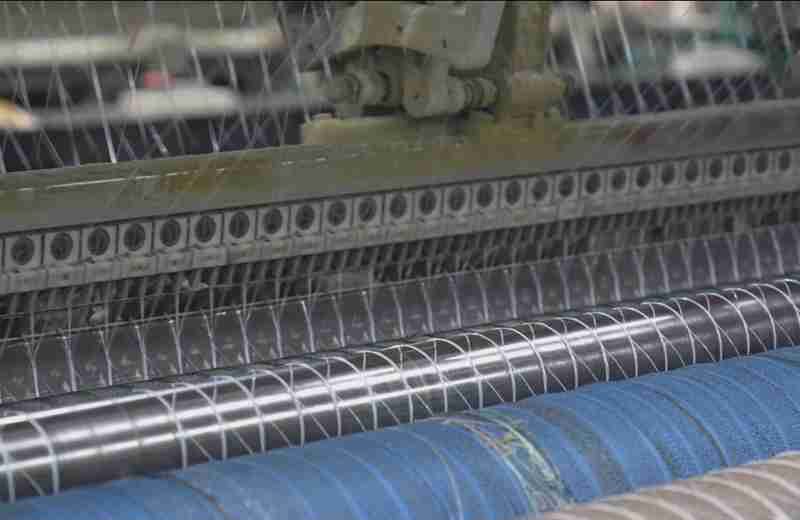
Next, the tapes are woven together on automatic Raschel or crochet knitting machines to form the characteristic open mesh pattern of net wrap.
Advanced weaving technology ensures even spacing, smooth edges, and minimal slippage during use. The goal is to achieve the right balance between coverage and air permeability — strong enough to hold the bale tightly, yet breathable enough to prevent moisture buildup.

4. Heat Setting and Stabilization
Once woven, the fabric undergoes heat setting, a process that stabilizes the material’s structure and dimensions.
By applying controlled heat and tension, manufacturers prevent the net wrap from shrinking or deforming under pressure. This step also enhances its elasticity, making it easier for farmers to handle during baling.
5. Quality Testing
Every roll of hay net wrap goes through strict quality control tests.
Key parameters tested include:
- Tensile strength
- Knot performance
- Mesh uniformity
- UV resistance
- Roll length and width accuracy
Only products that meet international agricultural standards move on to the packaging stage. This ensures reliable performance in all field conditions.

6. Rolling, Cutting, and Packaging
After passing quality checks, the large master rolls are cut and rewound into standard roll sizes—commonly 48″, 51″, 64″, or 67″ widths.
Each roll is precision-wound for smooth, even unrolling on modern balers.
Finally, rolls are wrapped in moisture-proof film and packed in durable cartons or pallets, ready for shipment worldwide.

7. Sustainability and Innovation
With the growing demand for eco-friendly solutions, manufacturers are now developing recyclable and compostable net wraps.
By using biodegradable polymers and improved production techniques, the industry is reducing its environmental footprint while maintaining performance.
This shift represents the future of sustainable farming and agricultural netting.
Conclusion
From raw polyethylene pellets to high-performance rolls ready for the field, every stage of net wrap production is designed for precision and reliability.
Understanding how net wrap is made helps farmers appreciate the technology behind each roll — ensuring efficient baling, longer storage life, and better crop protection.
Q1: What raw materials are used to make net wrap?
Net wrap is made primarily from high-quality polyethylene — typically virgin HDPE or LLDPE granules. UV stabilizers and antioxidants are added during production to protect the material from sunlight degradation and oxidation, ensuring durability throughout outdoor storage and field use.
Q2: How is the mesh structure of net wrap created?
The mesh structure is created using automatic Raschel or crochet knitting machines. Flat polyethylene tapes are woven into an open mesh pattern designed to balance coverage and air permeability — strong enough to hold a bale tightly while allowing moisture to escape through the gaps.
Q3: What quality tests does net wrap go through before packaging?
Every roll is tested for tensile strength, knot performance, mesh uniformity, UV resistance, and roll length and width accuracy. Only rolls that meet international agricultural standards proceed to the packaging stage, ensuring consistent field performance across different crop types and weather conditions.
Q4: What sizes does net wrap come in?
Net wrap rolls are typically cut to standard widths of 48 inch, 51 inch, 64 inch, or 67 inch, depending on the baler model and regional market. Each roll is precision-wound for smooth, even unrolling on modern round balers, and packed in moisture-proof film for shipping.
Q5: Why is UV stabilizer added to net wrap during manufacturing?
UV stabilizers are added to protect the polyethylene material from degradation caused by prolonged sun exposure. Without UV protection, net wrap becomes brittle and loses tensile strength quickly in the field. UV-stabilized net wrap maintains its performance across multiple seasons of outdoor storage.
Q6: Is net wrap recyclable?
Yes. HDPE and LLDPE net wrap is recyclable, and manufacturers are increasingly developing recyclable and compostable alternatives using biodegradable polymers. Choosing recyclable net wrap helps reduce agricultural plastic waste and supports more sustainable farming practices.
Q7: Can net wrap be custom manufactured for specific baler brands?
Yes. Net wrap can be produced in custom widths, lengths, and roll specifications to match the requirements of specific baler models and regional market standards. Contact Changzhou Xinhui Netting Co., Ltd. to discuss custom sizes, OEM production, or bulk order requirements.
Contact Us
Looking for a reliable net wrap manufacturer?
At Changzhou Xinhui Netting Co., Ltd., we specialize in producing high-quality bale net wrap, debris netting, and greenhouse shade cloth for global markets.
Contact us today to discuss custom sizes, OEM production, or bulk orders — and let’s help you wrap your harvest with strength and efficiency.
📩 Email: sale1@xinhuibalenetwrap.com
🌐 Website: www.xinhuibalenetwrap.com


