
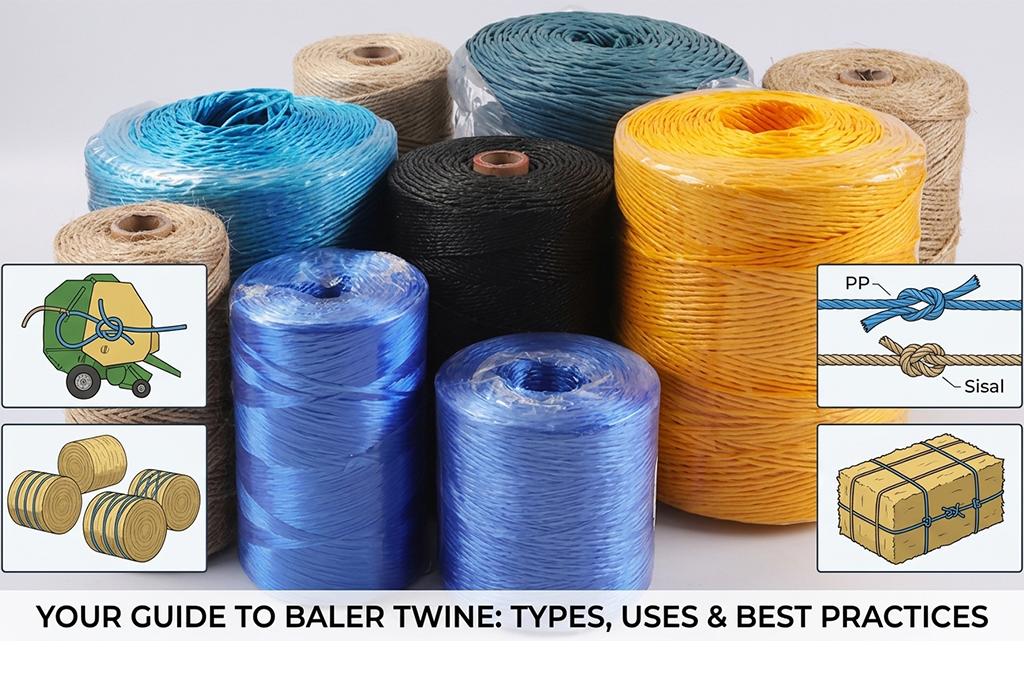
How Is Baler Twine Made? From Raw Material to Finished Product
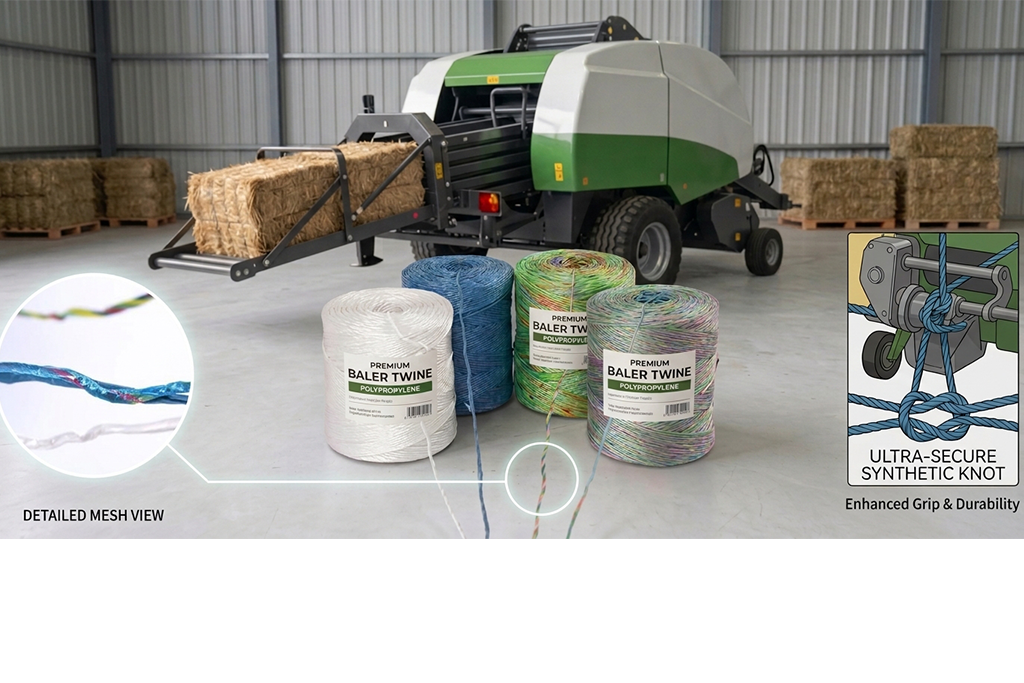
Baler twine may look like a simple piece of string, but producing reliable agricultural baler twine requires carefully controlled materials, extrusion, stretching, fibrillation, twisting, winding, and quality testing.
So, how is baler twine made?
For modern polypropylene baler twine, the process generally starts with polypropylene resin and selected additives. The raw material is melted and extruded into a thin film or tape, cooled, slit into narrow strips, stretched to improve its mechanical properties, fibrillated when required, and then twisted into twine. The finished twine is finally wound into rolls or spools and packaged for agricultural use.
The manufacturing process is important because baler twine must do more than simply hold a bale together. It needs to provide the appropriate combination of tensile strength, knot strength, flexibility, abrasion resistance, runnage, and consistent feeding through the baler’s knotter system.
This guide explains how baler twine is made, what materials are used, how polypropylene becomes finished twine, and which manufacturing factors affect performance in hay, straw, alfalfa, and other baling applications.
What Is Baler Twine Made From?
Most modern synthetic baler twine is manufactured primarily from polypropylene (PP). Depending on the product specification, the formulation may also include color pigments, UV stabilizers, and other additives designed to improve processing and outdoor performance.
In simple terms:
Polypropylene resin → extrusion → film/tape → stretching → fibrillation → twisting → winding → finished baler twine
Polypropylene is widely used because it can provide a useful combination of strength, low weight, flexibility, moisture resistance, and cost efficiency when it is processed correctly.
According to agricultural twine manufacturing guidance, the quality of the polypropylene resin and the extrusion process can directly affect knot formation, strength, and the consistency of the finished twine.
What Is Hay Baler Twine Made Of?
Hay baler twine can be made from polypropylene or natural sisal, depending on the product and application.
Polypropylene baler twine is a synthetic product manufactured from PP resin. Sisal baler twine is produced from natural plant fibers.
For synthetic hay baler twine, the basic manufacturing route is:
PP resin + additives → extrusion → tape formation → stretching → fibrillation → twisting → winding
The exact material formulation, tape dimensions, twist level, and processing conditions can vary according to the intended bale type and strength requirement.
What Is Polypropylene Baler Twine Made Out Of?
Polypropylene baler twine is primarily made from polypropylene resin.
The manufacturing formulation may include:
| Material / Component | Main Function |
|---|---|
| Polypropylene resin | Main structural material |
| Color pigment | Provides product identification and color |
| UV stabilizers | Helps improve resistance to outdoor UV exposure |
| Processing additives | Supports manufacturing and handling characteristics |
The exact formulation is manufacturer-specific. Some manufacturers describe their twine as containing high-quality polypropylene together with color pigment, additives, and UV stabilizers.
This is also why two baler twines with a similar advertised length or weight may not necessarily perform identically. Resin quality, tape dimensions, orientation, fibrillation, twisting, and final quality control can all affect the finished product.

How Is Baler Twine Made? The Manufacturing Process
Although production systems vary between manufacturers, polypropylene baler twine commonly follows several major stages.
1. Raw Material Selection
The process begins with polypropylene resin, normally supplied as pellets or another suitable raw-material form.
The manufacturer first selects the resin according to the required product characteristics. The intended application determines the required combination of strength, flexibility, runnage, knot performance, and processing stability.
For agricultural baler twine, raw-material consistency is particularly important because variations in the polymer can affect the finished tape and twine.
Low-quality or unsuitable raw materials can contribute to inconsistent strength and knot performance.
2. Mixing Color and Additives
Before extrusion, the polypropylene may be combined with selected additives.
Color pigment is commonly used to give the twine its finished color, while UV stabilizers may be incorporated to improve its resistance to outdoor exposure.
The additives must be controlled carefully. The objective is not simply to add more ingredients, but to achieve the required balance between processability and finished-product performance.
3. Extrusion: Turning PP Resin Into Film
The next major stage is extrusion.
The polypropylene material enters an extruder, where heat and mechanical shear melt and process the resin. The molten PP is then formed through a die into a continuous flat film or sheet.
This stage is fundamental to the manufacturing process because the dimensions and uniformity of the extruded film influence the characteristics of the final twine.
A typical manufacturing sequence is:
PP pellets → melting → mixing → flat-film extrusion → cooling
Agricultural twine manufacturing references describe extrusion as the process through which polypropylene is converted from its raw-material form into a continuous film or tape.
4. Cooling and Stabilizing the Film
After extrusion, the hot polypropylene film must be cooled and stabilized.
Cooling systems, including controlled rollers or cooling sections, help bring the film to the required condition for the next processing stages.
Uniform cooling is important because inconsistent film dimensions can affect subsequent cutting, stretching, and twisting.
At this stage, the product is still a flat plastic film rather than finished baler twine.
5. Slitting the Film Into Narrow Tapes
The cooled film is then cut into narrower strips or tapes.
The width and thickness of these strips are important manufacturing parameters because they influence the final twine’s weight, runnage, flexibility, and strength.
This is one reason why how thick is baler twine cannot be answered with one universal number.
Different baler twines can have different tape structures while delivering similar or different strength and runnage specifications.
The manufacturing literature notes that runnage can be achieved through thin, wide tape, while tape width and thickness also influence softness and knot formation.
6. Stretching and Orientation
After slitting, the polypropylene tapes are stretched under controlled conditions.
This step helps orient the polymer structure and can improve the mechanical properties of the material.
In practical terms, stretching is one of the reasons the original flat PP film can be transformed into a stronger material suitable for agricultural twine.
The exact draw ratio and processing conditions depend on the manufacturer’s equipment, material formulation, and desired product specification.
7. Fibrillation
Some polypropylene baler twine is fibrillated during manufacturing.
Fibrillation creates a network or structure of fine interconnected filaments within the tape.
Why is fibrillation important?
It can improve the tape’s behavior during twisting and contribute to the properties required for knotting and handling.
Manufacturing references describe fibrillation as a process that splits the tape longitudinally to improve twisting and knotting properties.
Modern baler-twine production equipment is specifically designed for fibrillated PP tape used in twine and rope production.
8. Twisting the Tape Into Twine
After the tape has been processed, it is twisted to create the final twine structure.
This is the stage where the flat or fibrillated tape is transformed into a continuous cylindrical-looking agricultural twine.
The amount and configuration of twisting affect important characteristics such as:
- Twine diameter
- Flexibility
- Knot behavior
- Handling
- Surface structure
- Strength
- Runnage
The objective is not simply to produce the thickest possible twine. The finished structure must be suitable for the intended baler and bale density.
9. Winding the Finished Twine
After twisting, the finished twine is wound onto the specified spool, ball, or package.
The winding process needs to produce a stable package that feeds consistently during baling.
A poorly wound package can cause feeding problems even when the underlying twine has adequate strength.
For agricultural users, consistent unwinding is therefore an important part of finished-product quality.
10. Quality Control and Packaging
Before shipment, manufacturers can evaluate the finished twine against the required specifications.
Typical quality-control considerations include:
- Linear density or runnage
- Roll or spool weight
- Tensile strength
- Knot strength
- Diameter or tape dimensions
- Twist consistency
- Appearance
- Feeding performance
- Packaging stability
The final product is then packed according to the customer’s requirements and prepared for palletization and shipment.

Baler Twine Manufacturing Process at a Glance
H2: Baler Twine Production Process
| Manufacturing Stage | What Happens | Why It Matters |
|---|---|---|
| Raw material selection | PP resin and selected additives are prepared | Establishes the material foundation |
| Mixing | Pigments and additives are combined | Provides color and processing characteristics |
| Extrusion | PP is melted and formed into film | Creates the basic tape material |
| Cooling | Film is cooled and stabilized | Maintains dimensional consistency |
| Slitting | Film is divided into narrow tapes | Determines tape structure |
| Stretching | Tape is oriented under controlled conditions | Improves mechanical properties |
| Fibrillation | Tape is split into interconnected fine filaments | Supports twisting and knotting |
| Twisting | Tape is twisted into twine | Creates the finished twine structure |
| Winding | Twine is wound onto rolls or spools | Enables stable feeding through the baler |
| Quality control | Strength, knot, dimensions and appearance are checked | Confirms product consistency |
| Packaging | Finished twine is packed and palletized | Protects the product during storage and transportation |
How Does Baler Twine Manufacturing Affect Strength?
When users ask how strong is baler twine, the answer depends on more than the material itself.
Strength can be affected by:
- Polypropylene resin quality
- Tape width and thickness
- Stretching and orientation
- Fibrillation
- Twist structure
- Finished linear density
- Manufacturing consistency
- Knot configuration
For baling applications, knot strength is particularly important because the twine is not used only as a straight strand. It must also maintain the bale when the knotter forms and secures the knot.
A twine can have high straight-line tensile strength but still require suitable knot performance for a specific baler application.
This is why agricultural twine specifications often distinguish between tensile strength and knot strength.
How Does Baler Twine Work After It Is Manufactured?
The manufacturing process determines the physical structure of the finished twine, but the baler’s knotting system determines how that twine is used.
During baling, the twine is fed from the package through the baler system. Depending on the baler type, the twine is positioned around or along the forming bale and then secured by the knotter mechanism.
For square balers, knot strength and consistent feeding are particularly important because the twine is subjected to the tying process and subsequent handling of the bale.
For round balers, twine is commonly wrapped around the bale to maintain its shape and hold the material together.
Therefore, the finished twine needs to match the baler’s design and operating conditions.
Some balers may also require adjustment when switching between twine types or manufacturers to achieve proper knotting performance.
Why Twine Size and Runnage Matter
One common mistake is choosing baler twine based only on thickness.
How thick is baler twine?
That depends on the product specification.
A better approach is to consider several parameters together:
- Twine length
- Twine weight
- Runnage
- Linear density
- Tensile strength
- Knot strength
- Bale type
- Bale density
- Baler manufacturer’s requirements
For example, two rolls may have similar weights but different lengths. Conversely, two products may have similar runnage but different tape structures.
Agricultural twine guidance specifically points out that runnage alone does not describe the complete physical structure of the tape; width and thickness can also influence softness and knot formation.
Is Plastic Baler Twine Made From Recycled Plastic?
This depends on the manufacturer and product specification.
Polypropylene baler twine can be manufactured using polypropylene resin, but not every product uses recycled material, and recycled content should not be assumed unless the manufacturer specifically states it.
For agricultural applications where consistent strength and knot performance are important, buyers should ask suppliers about:
- Virgin or recycled PP content
- Recycled-content percentage, if applicable
- Resin grade
- UV stabilization
- Strength specification
- Knot-strength specification
- Quality-control standards
If recycled material is used, the manufacturer’s specification should clearly state how it affects the product’s intended performance.
What Makes High-Quality Baler Twine?
A high-quality baler twine is not necessarily the thickest or heaviest twine.
The manufacturing process should produce a consistent combination of:
Consistent Dimensions
The tape and finished twine should have controlled dimensions throughout the production run.
Reliable Strength
The product should meet its specified tensile and knot-strength requirements.
Good Knot Performance
The twine needs to work correctly with the intended baler and knotter system.
Stable Runnage
Consistent length per unit weight helps users estimate twine consumption and bale-production requirements.
Smooth Feeding
The finished spool should unwind consistently without unnecessary tangling or package collapse.
Controlled Twist
An appropriate twist structure helps maintain the required combination of flexibility, strength, and knot performance.
How Much Twine Is Used for Corn Stalk Bales?
The answer depends on the baler, bale size, bale density, twine setting, and the type of bale being produced.
Therefore, how much twine on corn stalk bale cannot be determined from crop type alone.
Corn stalks can produce dense, abrasive bales, so the required twine specification should be selected according to the baler’s recommendations and the actual bale conditions.
For purchasing purposes, the most reliable calculation starts with the manufacturer’s estimated twine consumption per bale and the number of bales expected during the season.
Does Manufacturing Differ for Round and Square Baler Twine?
The basic polypropylene processing principles can be similar, but the final product specifications can differ significantly.
Round baler twine, small square baler twine, and large square baler twine may require different combinations of strength, size, length, and knot performance.
Round Baler Twine
Round-bale applications commonly emphasize suitable wrapping performance, flexibility, and sufficient strength for the bale.
Small Square Baler Twine
Small square bales require twine that can withstand the knotting and handling process while maintaining the required bale shape.
Large Square Baler Twine
Large square bales are generally heavier and denser, so the twine specification must be matched carefully to the baler and bale density.
The appropriate product should therefore be selected according to the baler manufacturer’s recommendations rather than simply choosing the heaviest available twine.
How Manufacturers Control Baler Twine Quality
A professional baler twine manufacturing process does not end when the twine is twisted.
Quality control should continue throughout production.
Manufacturers may monitor:
- Raw-material consistency
- Film thickness
- Tape width
- Stretching conditions
- Fibrillation quality
- Twist consistency
- Runnage
- Roll weight
- Tensile strength
- Knot strength
- Winding quality
- Packaging
This matters because small variations introduced during extrusion or twisting can become more significant when thousands of meters of twine are used in agricultural operations.
From Polypropylene Resin to Agricultural Baler Twine
The complete process can be summarized as follows:
Polypropylene resin → additives and pigment → extrusion → cooling → slitting → stretching → fibrillation → twisting → winding → quality control → packaging
Each stage contributes to the final performance of the twine.
The raw material determines the starting point. Extrusion creates the film structure. Stretching and fibrillation modify the material’s mechanical and handling characteristics. Twisting creates the final twine structure, while winding and quality control ensure that the product can be used reliably in the field.
That is why how baler twine is made is directly connected to how the finished product performs during baling.
FAQ: How Is Baler Twine Made?
How is baler twine made?
Most polypropylene baler twine is made by extruding polypropylene resin into film, cooling and slitting the film into narrow tapes, stretching the tapes, fibrillating them when required, twisting them into twine, and winding the finished product onto spools or rolls.
What is baler twine made from?
Synthetic baler twine is primarily made from polypropylene resin. Manufacturers may also use color pigments, UV stabilizers, and other processing additives.
What is hay baler twine made of?
Hay baler twine can be made from polypropylene or natural sisal. Polypropylene is widely used for synthetic agricultural baler twine because of its combination of strength, flexibility, moisture resistance, and processing consistency.
What is polypropylene baler twine made out of?
Polypropylene baler twine is primarily produced from polypropylene resin. Depending on the product specification, pigments, UV stabilizers, and other additives may also be incorporated.
How strong is baler twine?
Baler twine strength varies by product specification. Resin quality, tape dimensions, stretching, fibrillation, twisting, and final construction can all affect tensile and knot strength.
How thick is baler twine?
There is no single universal thickness for baler twine. Different products are manufactured for different balers, bale sizes, and strength requirements. Buyers should compare the manufacturer’s specified linear density, runnage, tensile strength, knot strength, and other dimensions.
Is plastic baler twine made from recycled plastic?
Some plastic twine products may contain recycled material, but this varies by manufacturer and product. Buyers should confirm the recycled-content specification directly with the supplier rather than assuming that polypropylene baler twine is made from recycled plastic.
How much twine is used for a bale?
Twine consumption depends on bale dimensions, bale density, the number of ties or wraps, baler settings, and twine specifications. The manufacturer’s recommended consumption or actual field usage provides a more accurate estimate than crop type alone.
Can the manufacturing process affect knot strength?
Yes. Material quality, tape dimensions, orientation, fibrillation, twisting, and manufacturing consistency can all affect the finished twine’s knot performance. The final product must also be compatible with the baler’s knotter system.
Why is polypropylene commonly used to make baler twine?
Polypropylene can provide a useful combination of strength, low weight, flexibility, moisture resistance, and cost efficiency. It can also be processed into fibrillated tape and twisted twine suitable for agricultural baling applications.
Changzhou Xinhui Netting Co., Ltd. Professional baler twine suppliers | OEM & Private Label | Factory Direct Pricing
📧 : sale1@xinhuibalenetwrap.com
🌐 : https://xinhuibalenetwrap.com
Request a Free Quote Today →
Supplying farms, co-operatives, and distributors across North America, Europe, Japan, Australia, and worldwide.


