

Truckload vs. Single Roll: How Cooperative Buying Can Save You 60%+ on Netting
Introduction: You’re Paying the Most Expensive Price in the Supply Chain
Every time you walk into a farm supply store and pull a net wrap roll off the shelf, you are paying at the end of a supply chain that has added margin at every step between the factory and your hands. The manufacturer sold it to a distributor. The distributor sold it to a regional wholesaler. The wholesaler sold it to the retailer. The retailer added their margin on top. By the time the roll reaches the shelf, the retail price may be two or three times the factory cost.
You are not paying for a better product at retail. You are paying for the convenience of buying one roll at a time.
And here is what makes this genuinely frustrating: the farmers in your county, collectively, are buying enough net wrap every season to fill a shipping container or a truckload. If that volume were purchased together — coordinated across five, ten, or twenty neighboring farms — it would access a completely different pricing tier. Not retail pricing. Factory pricing. Or close to it.
This is the logic behind cooperative net wrap buying — and it is not complicated to organize. It requires a few neighboring farms willing to coordinate a single annual purchase, a reliable manufacturer who supplies in volume, and someone willing to make two phone calls. The savings — typically over 60% per roll compared to retail single-roll purchasing — compound across every roll, every season, for as long as the buying group stays together.
This article shows you exactly how it works, how to organize it, and how Changzhou Xinhui Netting Co., Ltd. supplies buying groups, informal farm cooperatives, and organized purchasing arrangements with factory-direct pricing that retail simply cannot match.
The Price Stack: Why Single-Roll Retail Is So Expensive
To understand why cooperative buying saves so much, you need to understand what you are actually paying for when you buy a single net wrap roll at retail.
The Full Supply Chain Margin Stack
Level 1 — Manufacturer The net wrap is produced. Manufacturing cost includes raw material (HDPE resin, UV stabilizers), production labor, equipment depreciation, quality control, and factory overhead. This is the base cost.
Level 2 — Export Agent / Trading Company (not always present) Some manufacturers sell through export trading companies rather than directly to international buyers. The trading company adds a margin — typically 5–15% — for handling the export transaction, documentation, and logistics coordination.
Level 3 — Importer / National Distributor The product enters the destination country through an importer or national distributor. They add margin — typically 15–25% — for import handling, customs clearance, domestic warehousing, and national distribution.
Level 4 — Regional Wholesaler The national distributor sells to regional wholesalers who maintain local stock. Regional wholesaler margin: typically 10–20%.
Level 5 — Retail Store The farm supply store sells to the individual farmer. Retail margin: typically 20–35%.
The cumulative effect:
| Supply Chain Stage | Illustrative Cumulative Markup |
|---|---|
| Factory cost | Base price |
| + Export agent margin | +5–15% |
| + National distributor margin | +15–25% |
| + Regional wholesaler margin | +10–20% |
| + Retail margin | +20–35% |
The compounding effect of these layers means that a standard 48″ × 9,840 ft net wrap roll commonly retails in the US market anywhere from $200 to over $300 per roll depending on the brand and the channel — entry-level brands at the lower end, premium and dealer-exclusive brands at the higher end. In every case, the product that left the factory at a fraction of that price has passed through multiple hands before reaching yours.
Cooperative buying’s power is that it jumps most of this stack. A buying group purchasing directly from a manufacturer pays factory cost plus direct shipping — every distribution layer in between is eliminated.
The Math: What Cooperative Buying Actually Saves
Single Farm, Single Roll Retail: The Baseline
Based on current conditions in the US market, a standard 48″ × 9,840 ft (3,000 m) net wrap roll can cost anywhere from $200 to over $300 per roll at retail depending on the brand and channel — with entry-level brands at the lower end and dealer-exclusive premium brands at the higher end.
For the illustrative model below, we use $230 per roll as a mid-market retail reference point. If you are currently buying through a dealer or paying for a premium brand, your actual baseline may be higher — which only strengthens the case for cooperative purchasing.
All figures in the tables below are illustrative examples. Actual retail prices vary by brand, region, and season. Contact us for a current factory-direct quote to calculate your specific savings.
Illustrative annual net wrap cost, single farm buying retail at $230/roll:
| Annual Bales | Rolls Required (at 250 bales/roll) | Cost at $230/roll |
|---|---|---|
| 250 bales | 1 roll | $230 |
| 500 bales | 2 rolls | $460 |
| 1,000 bales | 4 rolls | $920 |
| 2,000 bales | 8 rolls | $1,840 |
| 5,000 bales | 20 rolls | $4,600 |
Cooperative Group: The Alternative
A buying group coordinates their seasonal purchase into a single factory-direct order, eliminating every distribution layer.
Factory-direct pricing from Changzhou Xinhui Netting Co., Ltd. for equivalent specification is significantly lower than retail — the exact price depends on specification, volume, and shipping destination, but the gap versus retail is substantial. Contact us for a current quote to calculate your group’s specific saving.
For the illustrative model below, we use a factory-direct reference price of $X per roll — represented in the tables as a placeholder. To make the math concrete, we show two scenarios: one assuming a factory price that is 60% below retail, and one at 70% below retail, both of which are realistic depending on volume and specification.
Rather than leaving you with placeholders, here is the model at our illustrative factory-direct price of $70/roll — a figure in the range realistic for volume direct purchasing, used here purely as a calculation example. Your actual quoted price may differ — request a quote for the precise number.
All figures below are illustrative examples based on a factory-direct reference price of $70/roll and a retail baseline of $230/roll. These numbers are for comparison purposes only. Contact Changzhou Xinhui Netting for a current factory-direct quote for your exact specification and volume.
Illustrative annual net wrap cost, cooperative buying at factory-direct pricing:
| Annual Bales | Rolls Required | Retail Cost ($230) | Factory-Direct ($70 example) | Illustrative Saving |
|---|---|---|---|---|
| 250 bales | 1 roll | $230 | $70 | ~$160 |
| 500 bales | 2 rolls | $460 | $140 | ~$320 |
| 1,000 bales | 4 rolls | $920 | $280 | ~$640 |
| 2,000 bales | 8 rolls | $1,840 | $560 | ~$1,280 |
| 5,000 bales | 20 rolls | $4,600 | $1,400 | ~$3,200 |
These are individual farm savings. Now look at what the buying group saves collectively.
Buying Group Collective Savings
Using the same illustrative figures ($230 retail / $70 factory-direct example), here is what a buying group saves collectively:
A group of 10 farms, each baling an average of 1,000 bales per season:
| Metric | Calculation | Illustrative Amount |
|---|---|---|
| Total rolls needed | 10 farms × 4 rolls | 40 rolls |
| Retail cost | 40 rolls × $230 | $9,200 |
| Factory-direct cost | 40 rolls × $70 (example) | $2,800 |
| Total group saving | ~$6,400 per season | |
| Per-farm saving | ÷ 10 farms | ~$640 per farm per season |
A group of 20 farms averaging 2,000 bales each:
| Metric | Calculation | Illustrative Amount |
|---|---|---|
| Total rolls needed | 20 farms × 8 rolls | 160 rolls |
| Retail cost | 160 rolls × $230 | $36,800 |
| Factory-direct cost | 160 rolls × $70 (example) | $11,200 |
| Total group saving | ~$25,600 per season | |
| Per-farm saving | ÷ 20 farms | ~$1,280 per farm per season |
Disclaimer: All figures above are illustrative examples for comparison purposes. The $230 retail figure represents a mid-market reference based on current US market conditions. The $70 factory-direct figure is a hypothetical example — actual factory-direct pricing from Changzhou Xinhui Netting depends on specification, volume, and shipping destination. Contact us for a current quote to calculate your buying group’s actual savings.
How to Organize a Net Wrap Buying Group
The most common reason farmers don’t participate in cooperative buying is not skepticism about the savings — it is inertia. Nobody wants to be the one who makes the calls, collects the money, and coordinates the logistics. This section makes that job as simple as possible.
The Minimum Viable Buying Group
You do not need a formal legal structure, a committee, or a constitution to run a net wrap buying group. The minimum viable structure is:
- 2–5 neighboring farms willing to coordinate a single annual purchase
- One person willing to collect orders, place a single purchase, and coordinate delivery
- A shared delivery point — one farm where the shipment arrives and rolls are picked up
That is it. Everything else is optional.
Step 1: Identify Your Group
Start with farms you already know. Neighbors within a 10–15 mile radius who you see at the co-op, at the machinery dealer, or at the county fair. Ask a simple question: “Are you interested in buying net wrap together this year to get a better price?”
Most farmers will say yes — particularly if you can tell them roughly what the saving looks like. “We think we can cut our net wrap cost by more than half by buying direct from the factory together” is a compelling opening that needs no further explanation.
You do not need large numbers to start. Even 3–4 farms combining their purchases gets you out of single-roll retail pricing and into meaningful volume territory.
Step 2: Collect Specifications
Once you have interested farms, collect three pieces of information from each:
- Net wrap width needed (48″, 51″, 64″, 67″, or European size)
- Net weight (most farms use 8 g/m² for standard hay — confirm if anyone needs 9 g/m² for alfalfa or silage)
- Number of rolls needed for the season (with a small buffer — better to order slightly more than run short mid-season)
Keep this information in a simple spreadsheet — farm name, width, weight, roll quantity. This is your purchase order for the manufacturer.
Step 3: Standardize Where Possible
The buying group achieves the best pricing when it orders a standardized specification rather than a dozen different variants. If most farms need 48″ × 8 g/m², try to standardize the group on this specification even if a couple of farms would prefer 51″. The additional 3 inches of width on a 51″ roll works in 48″-compatible balers in most cases — check your operator’s manual.
If your group genuinely needs multiple widths — because the farm mix includes both 48″ and 51″ baler owners — order both, but keep the number of SKUs to a minimum. Two widths at one weight is manageable. Five widths at three weights creates logistics complexity that erodes the group’s organizational efficiency.
Step 4: Calculate Total Volume and Contact the Manufacturer
With your group’s specifications consolidated, you have a purchase order. Contact Changzhou Xinhui Netting Co., Ltd. with:
- Total rolls needed by specification (e.g., 30 rolls of 48″ × 8 g/m², 10 rolls of 51″ × 8 g/m²)
- Delivery destination (nearest major port or warehouse address)
- Desired delivery timing (when do you need the rolls before baling season begins?)
We will provide factory-direct pricing, freight cost estimate, and lead time for your volume. You will have everything you need to calculate the per-roll landed cost for your group.
Step 5: Collect Payment and Place the Order
With pricing confirmed, collect payment from group members before placing the order. The simplest structure is:
- Calculate landed cost per roll (factory price + freight + any import costs, divided by total rolls)
- Add a small buffer (5–10%) for unexpected costs
- Collect that amount per roll from each member before the order is placed
- Place the order and track the shipment
The person coordinating the purchase can be compensated for their time by taking a small per-roll coordination fee — $1–2 per roll across the group is a reasonable and transparent way to recognize the organizer’s contribution.
Step 6: Receive and Distribute
When the shipment arrives at the agreed delivery point, each farm picks up their rolls. For palletized deliveries, a tractor with a loader or a forklift makes this straightforward.
If your group is spread across a wider area, you can arrange secondary delivery within the group — one farm with a flatbed trailer can deliver rolls to other members for a small fee, or members can simply collect their allocation with their own equipment.
Beyond Net Wrap: What Cooperative Buying Can Become
A net wrap buying group that functions well in its first season naturally evolves. The organizational infrastructure — the list of members, the coordination process, the manufacturer relationship — is reusable for any agricultural input where volume pricing creates meaningful savings.
Other Inputs Where the Same Logic Applies
Silage stretch film Stretch film for bale wrapping follows the same supply chain economics as net wrap. A buying group that sources net wrap together can add stretch film to the same shipment with minimal additional coordination effort.
Twine For farms that still use sisal or poly twine for square baling or other applications, twine purchasing in volume follows identical economics to net wrap.
Agricultural films Greenhouse films, mulch films, and tunnel films are all HDPE-based agricultural inputs where factory-direct volume pricing creates substantial savings versus retail.
Crop inputs Fertilizer, seed, and crop protection products all have volume pricing structures that reward coordinated purchasing. A well-organized buying group that proves itself on net wrap has the trust and operational infrastructure to take on more complex cooperative purchasing.
When an Informal Group Becomes a Formal Structure
Some buying groups that start as informal neighbor arrangements grow into something more formal — a registered cooperative, a purchasing club, or an affiliated buying group within an existing agricultural organization. This formalization makes sense when:
- Group membership grows beyond 15–20 farms
- Annual purchase volume justifies a dedicated coordinator role
- The group wants to extend into more complex products or services
- Legal and financial clarity becomes important for larger transactions
Formalization is not necessary at the outset — it is an option that becomes relevant as the group proves its value and grows. Most successful cooperative buying groups start informal and formalize only when the scale makes it worthwhile.
Logistics: Getting a Truckload to Rural Farms
One practical concern that stops some farms from exploring volume purchasing is logistics. How does a pallet or container of net wrap get from a Chinese factory to a rural farm address?
The answer is more straightforward than most operators expect.
Ocean Freight to Port
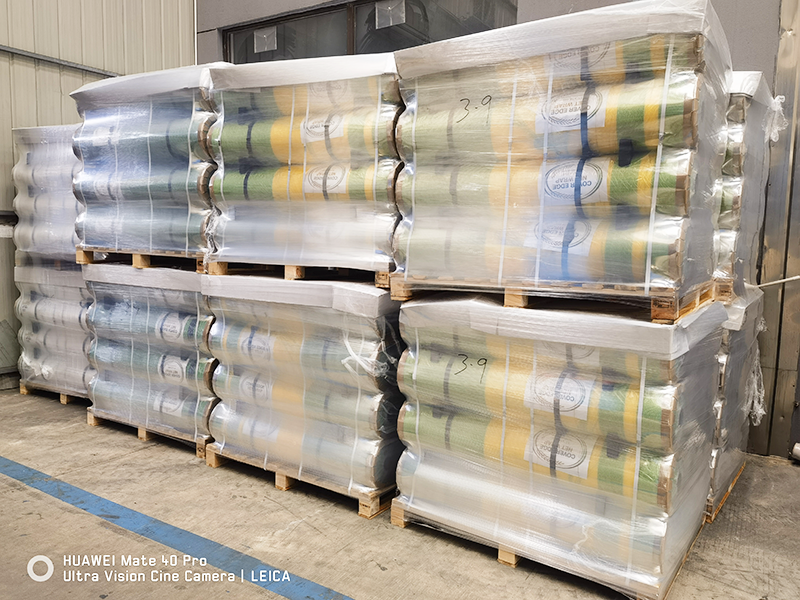
Net wrap ships in standard 20-foot or 40-foot containers from Chinese ports to destination ports in North America, Europe, or elsewhere. Ocean freight is arranged through a freight forwarder — a specialist who handles booking, documentation, and customs clearance. Your freight forwarder can be recommended by the manufacturer or found independently.
A 40-foot container holds approximately 800–1,200 rolls of standard 48″ net wrap depending on palletization — more than enough for a buying group of 20–30 farms.
Ocean freight transit time:
- China to US West Coast: approximately 14–21 days
- China to US East Coast: approximately 28–35 days
- China to Northern Europe: approximately 25–35 days
Port to Farm
From the port, the container is trucked to a domestic delivery point. For a buying group, this delivery point is typically the farm with the best access for a semi-trailer — a concrete yard, a covered storage area, or a large barn with wide access.
Domestic trucking from port to farm is arranged through standard freight carriers. The freight forwarder who handles the ocean shipment can often coordinate domestic delivery as well.
Storage Until Distribution
Rolls are stored at the receiving farm until group members collect their allocation. Net wrap rolls store well — they are UV stabilized and can be stored outdoors under a tarp or in open storage for a season without quality deterioration. A covered barn or shed is ideal but not essential for storage periods of 2–4 months.

Changzhou Xinhui Netting Co., Ltd. — The Manufacturing Partner for Buying Groups
Changzhou Xinhui Netting Co., Ltd. is a professional net wrap manufacturer that has supplied informal farm buying groups, agricultural purchasing cooperatives, and volume-purchasing distributors across North America, Europe, Japan, and globally.
We understand the needs of buying groups specifically:
Flexible minimum order quantities We work with buying groups at a range of volume levels — from small informal groups of 3–5 farms placing their first combined order, to established purchasing cooperatives ordering container quantities seasonally. Contact us with your group’s volume and we will confirm the minimum that works for factory-direct pricing.
Single specification or mixed orders If your group needs two widths and two weights, we produce and ship all specifications in a single consolidated order — simplifying logistics for the group coordinator.
Factory-direct pricing No trading company, no import agent, no distributor. Your buying group pays factory pricing plus direct freight — the shortest, most transparent supply chain available for agricultural net wrap.
Consistent quality 100% virgin HDPE, UV stabilized, consistently wound. Your group members need to trust that every roll performs the same way — and consistent manufacturing quality is what makes that trust warranted.
Private label for established groups Buying groups that grow into formal cooperative structures can explore private label manufacturing — putting the cooperative’s own brand on the product. This is a natural evolution for groups that achieve sufficient volume and organizational maturity.
Standard Specifications Available for Group Orders
| Width | Length | Net Weight | Core | Bales Per Roll* |
|---|---|---|---|---|
| 48″ (122 cm) | 3,000 m | 7 / 8 / 9 / 10 / 12 g/m² | 3″ | 200–280 |
| 51″ (130 cm) | 3,000 m | 7 / 8 / 9 / 10 / 12 g/m² | 3″ | 200–280 |
| 64″ (163 cm) | 2,134 m | 7 / 8 / 9 / 10 / 12 g/m² | 3″ | 150–220 |
| 67″ (170 cm) | 2,134 m | 7 / 8 / 9 / 10 / 12 g/m² | 3″ | 150–220 |
| 1.23 m | 2,000 m / 3,000 m | 7 / 8 / 9 / 10 / 12 g/m² | 3″ | 200–280 |
| 1.25 m | 2,000 m / 3,000 m | 7 / 8 / 9 / 10 / 12 g/m² | 3″ | 200–280 |
| 1.30 m | 3,600 m | 7 / 8 / 9 / 10 / 12 g/m² | 3″ | 240–340 |
*At 2.5–3.5 wraps per bale. Adjust inventory planning to the lower end for large-diameter bales.
Frequently Asked Questions
Q: How many farms do we need to get volume pricing?
A: There is no fixed threshold. As a general guide, buying groups achieve meaningful price improvements over retail starting at approximately 20–40 rolls combined — achievable with as few as 3–5 farms depending on individual farm scale. The more volume the group combines, the better the pricing. Contact us with your group’s estimated total volume for specific pricing.
Q: What if farms in my group need different net wrap widths?
A: Mixed-specification orders are straightforward to manage. Consolidate your group’s requirements by specification, confirm the total volume per specification, and we produce and ship all specifications in a single consolidated order. The group coordinator separates rolls by specification at the delivery point.
Q: How do we handle payment across multiple farms?
A: The simplest approach is for the group coordinator to collect payment from all members before placing the order — eliminating any receivables risk. Each member pays the coordinator their allocated cost per roll times their roll quantity, and the coordinator places and pays for the single consolidated order. Transparency about the per-roll cost calculation is important — sharing the manufacturer invoice and freight cost with group members builds trust in the process.
Q: What if we order too many rolls and have leftover stock?
A: Leftover net wrap is not a problem if stored correctly. Rolls stored in a cool, dry location away from direct sunlight will maintain quality for 2–3 seasons. Some groups deliberately order a small buffer above their season’s expected need — better to have spare rolls than to run short mid-season. Excess rolls can also be offered to group members who underestimated their needs, or rolled into the next season’s order.
Q: Can we get a sample roll before committing to a group order?
A: Yes. Sample rolls are available to evaluate product quality before a group order is placed. Contact us to discuss sample availability for your specification.
Q: Do we need a formal legal structure to place a group order?
A: No. We supply to informal buying groups as readily as to formal cooperative organizations. The purchase is a straightforward commercial transaction — one party places the order, one payment is made, one shipment is delivered. The internal coordination among group members is entirely your arrangement.
Q: How far in advance should we plan our group order?
A: For a first-time group order, plan 16–20 weeks before you need the rolls — this allows time for order coordination, production, ocean freight, and import clearance. Once your group has an established relationship with us and the logistics process is familiar, subsequent orders can be planned on a shorter cycle. Pre-season planning in late winter for a spring baling season is the most common timing.
Q: Can a buying group eventually become a private label customer?
A: Yes — and this is a natural progression for groups that grow in volume and organizational maturity. Once a buying group is consistently ordering container quantities seasonally, the step to private label manufacturing is straightforward. We work with cooperative clients at every stage of this progression.
Conclusion: The Call That Pays for Itself
Organizing a net wrap buying group requires one person to make a few calls, collect some information, and coordinate a single annual purchase. That investment of time — realistically a few hours across the season — can cut your net wrap cost by more than half for every member of the group, every season, indefinitely.
Based on the illustrative model in this article, a farm buying 4 rolls a year could save in the range of $600+ annually. A 20-farm buying group could collectively retain over $25,000 per season that previously went to the retail distribution chain. Your actual numbers depend on your current retail price and the factory-direct quote for your specification — contact us and we will calculate it precisely for your group.
The savings are real. The logistics are manageable. The manufacturing quality from a professional factory-direct supplier is equivalent to the branded retail product you are currently buying. The only thing standing between your buying group and these savings is the first conversation with your neighbors and the first call to a manufacturer.
Changzhou Xinhui Netting Co., Ltd. is ready for that call. Contact us with your group’s estimated volume, specification requirements, and target delivery timing — and we will show you what factory-direct pricing looks like for your situation.
Contact Changzhou Xinhui Netting Co., Ltd.
Changzhou Xinhui Netting Co., Ltd. Professional Net Wrap Manufacturer | OEM & Private Label | Factory Direct Pricing
📧 : sale1@xinhuibalenetwrap.com
🌐 : https://xinhuibalenetwrap.com
Get Volume Pricing for Your Buying Group Today →
Supplying farm buying groups, cooperatives, and distributors across North America, Europe, Japan, Australia, and worldwide.


