Claas Variant 485: Fixing the “Lazy Wrap” Problem — When Your Bale Starts Unwrapping in the Field

If you run a Claas Variant 485, you already know it’s one of the most reliable fixed-chamber balers on the market. But even a well-maintained machine can develop an annoying and costly issue: “lazy wrap.” This is when the net leaves the baler loosely, fails to hug the bale tightly, or the bale visibly starts to loosen and unravel within hours — sometimes minutes — of being dropped in the field.
For hay and straw producers, this isn’t cosmetic. A loosely wrapped bale loses shape, sheds outer layers, lets in moisture, and can fall apart during transport or stacking. If you’ve been searching why is my baler wrapping bales loose, understanding the real causes — and fixing both the machine and the net wrap itself — can save real money in feed loss, rebaling labor, and wasted field time during a narrow weather window.
What Exactly Is “Lazy Wrap”?
Lazy wrap describes a net wrap application that lacks proper tension. Instead of binding snugly around the bale under consistent pressure, the net is applied loosely, unevenly, or with visible slack. Typical symptoms:
- The bale “breathing” or expanding after ejection
- Loose net edges or sagging sections around the circumference
- The bale slowly sagging out of round within the first day
- Net that tears away easily at the edges when handled
- Visible gaps between wrap layers when you cut into the bale later
In most cases, lazy wrap results from several factors working together — machine wear and net wrap tension problems — not a single mechanical fault. That’s why two operators running the same baler model, in the same field, on the same day, can get very different results depending on how their machine is maintained and what net wrap they load.
Common Causes of Lazy Wrap on the Claas Variant 485
| Cause | What Happens | How to Confirm It |
|---|---|---|
| Net brake tension wear | Brake pads/springs lose resistance, net feeds too freely | Inspect net brake tension against Claas service spec |
| Incorrect wrap count | Too few wraps for crop density/moisture | Check current settings vs. crop type |
| Net roll storage/humidity | Net stretches unevenly or loses elasticity before use | Check roll storage conditions (temperature, sunlight) |
| Low tensile-strength net wrap | Net can’t hold tension once bale pressure applies | Swap in a known-good roll and compare |
| Chamber pressure mismatch | Bale doesn’t build enough internal pressure to resist net | Review density readouts vs. crop condition |
| Worn feed rollers or guide arms | Net doesn’t track evenly across the bale width | Watch net path during a slow-speed test cycle |
Each of these causes can exist on its own, but in the field they usually compound. A slightly worn brake combined with a lower-tensile net roll, for example, produces a much worse result than either issue alone — which is why troubleshooting only the machine, or only the net wrap, often doesn’t fully solve the problem.

Recommended Net Wrap Specification to Prevent Lazy Wrap
Choosing the right bale net wrap specification is often the overlooked half of the fix. Below is a general reference range suited to fixed-chamber balers like the Variant 485 — always confirm exact roll width against your machine’s operator manual, since chamber and net-brake configurations vary by model year.
| Parameter | Recommended Range | Why It Matters |
|---|---|---|
| Net weight (gauge) | 8–10 g/m² for hay/straw; 10–12 g/m² for high-density or silage bales | Heavier gauge resists stretch and holds tension longer |
| Roll width | 51″ (1.3m) or 64″ (1.63m), matched to chamber setting | Mismatched width causes uneven edge coverage |
| Roll length | Up to 3000m / 9840ft per roll | Longer rolls reduce mid-field roll-change downtime |
| Material | 100% virgin HDPE with UV stabilizer | Prevents brittleness and inconsistent break strength |
| Color | White, green, blue, yellow (custom available) | Field visibility and brand identification |
Reference specs based on standard bale net wrap manufacturing ranges (Xinhui Netting product data). Confirm exact fitment with your baler’s operator manual.
Step-by-Step Diagnosis
- Inspect the net brake assembly — check pad wear and spring tension against Claas service specs.
- Test with a fresh, known-quality net roll — if a good roll wraps tightly, the issue is the net supply, not the machine.
- Check bale density readouts — confirm the chamber reaches target density before the net cycle begins.
- Review wrap count settings — increase wraps by 1–2 for lighter or shorter-fiber crops.
- Check storage conditions of net rolls — rule out humidity or heat damage.
- Watch the net feed path at slow speed — look for wandering, uneven tracking, or drag on one side of the roll.

Hands-On: How to Test Net Wrap Before the Season Starts
Most operators only discover a weak net wrap roll after several bales have already come loose in the field — usually during the busiest part of the season. A short pre-season test, done in five minutes in the yard, can catch the problem before it costs you time and feed.
Step 1 — Visual check of the roll. Unroll about a meter of net by hand. It should feel firm and springy, not limp or brittle. Brittle netting that cracks or feels stiff when folded has likely been degraded by heat or UV exposure in storage.
Step 2 — Manual stretch test. Hold a section of net between both hands and pull firmly. A properly specified net wrap should stretch slightly and then return close to its original length once released. If it stretches a long way and stays stretched, or snaps with light pressure, that roll is unlikely to hold bale tension in the field.
Step 3 — Load a single test bale. Before committing a full field run to a new batch of net wrap, bale one load at your normal chamber density and let it sit for 24 hours. Check the bale the next morning for sagging, loose edges, or shape loss compared to a bale wrapped the previous season.
Step 4 — Cross-check with the brake setting. If the test bale still comes out loose even with net that passed the stretch test, the issue is almost certainly on the machine side — most likely net brake tension — rather than the net wrap itself.
Step 5 — Log the result. Keep a simple note of which net wrap batch, brake setting, and crop condition produced a tight, well-held bale. This becomes your reference point for the rest of the season, and for reordering net wrap that performs consistently on your specific machine.
Running this test at the start of each season — and again anytime you switch to a new net wrap supplier or batch — is the single most effective habit for avoiding lazy wrap before it becomes a field problem.
How to Fix Lazy Wrap
- Replace worn net brake components at the start of each season, not just when problems appear.
- Increase net wrap overlap for crops prone to loosening (light straw, short-chop hay).
- Store net wrap rolls in a cool, dry place, away from direct sunlight, in original packaging until use.
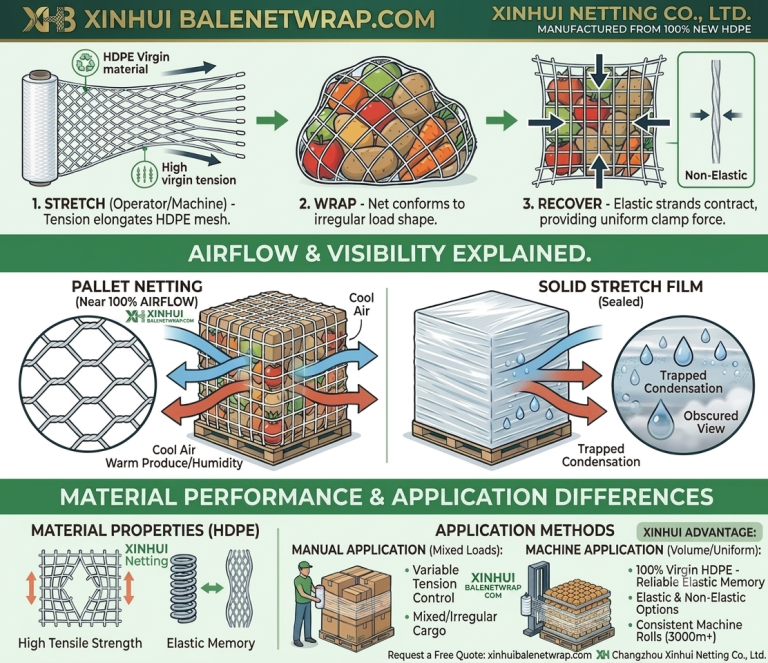
- Upgrade to a net wrap with proven tensile strength and stretch-recovery — this compensates for minor tension inconsistencies in the machine itself.
- Match chamber settings to crop condition throughout the day as moisture changes.
- Rotate older net wrap stock first, and avoid carrying rolls over multiple seasons in outdoor storage.
Pre-Season Net Wrap Checklist
Use this quick checklist before your first field day each season:
- [ ] Net brake pads and springs inspected and replaced if worn
- [ ] Net feed rollers and guide arms checked for wear or misalignment
- [ ] Net wrap rolls stored in dry, shaded conditions confirmed
- [ ] Fresh roll passed the manual stretch test
- [ ] Test bale wrapped and checked after 24 hours
- [ ] Wrap count settings reviewed against expected crop conditions
Where Net Wrap Quality Comes From
Consistent lazy-wrap prevention starts before the roll ever reaches the baler. Net wrap manufactured from 100% virgin HDPE with UV stabilizers holds tensile strength and elasticity more reliably across a full season than reprocessed or blended material — which is where inconsistent break strength and premature stretching typically originate. Xinhui Netting produces bale net wrap in a range of widths (48″–67″), weights (7–12 g/m²), and roll lengths up to 3000m, manufactured at a 25,000㎡ facility in Changzhou, China, and supplied to hay, straw, and silage producers across Europe, North America, South America, and Australia.
FAQ
Q: What roll width of net wrap fits the Claas Variant 485?
A: Most fixed-chamber Claas balers, including the Variant 485, use net wrap in the 51″ (1.3m) to 64″ (1.63m) range, but the exact width depends on your model’s chamber and net-brake configuration — always check the operator’s manual before ordering.
Q: Does a heavier net wrap gauge (g/m²) prevent lazy wrap?
A: A heavier gauge, typically 10–12 g/m² for high-density or silage bales, generally resists stretch better under baling pressure and helps maintain consistent tension, though it should be matched with proper brake maintenance for full effect.
Q: How is lazy wrap different from a net wrap break?
A: Lazy wrap is a tension problem — the net applies but stays loose — while a net wrap break is a mechanical failure where the net snaps mid-cycle; both can stem from similar root causes like worn brakes or weak net material, but they show up differently in the field.
Q: Can net wrap storage conditions really affect bale tightness?
A: Yes — net wrap exposed to high humidity, heat, or direct sunlight before use can lose elasticity and tensile consistency, which shows up as loose or uneven wrapping even on a properly functioning baler.
Q: Should I change net wrap settings when switching between hay and straw?
A: Yes — straw is typically lighter and less dense than hay, so increasing wrap count by 1–2 layers or switching to a higher-gauge net wrap is often necessary to maintain proper bale tension.
Q: How long can net wrap rolls be stored before they lose quality?
A: Properly stored net wrap — kept dry, cool, and out of direct sunlight in original packaging — can typically be stored for a full season or more without significant loss of tensile strength, while poor storage conditions can degrade it within a matter of months.
Q: What’s a simple way to test net wrap quality before a full field run?
A: Unroll a short section by hand and check that it feels firm rather than brittle, perform a manual stretch test to confirm it returns close to its original length, and wrap one test bale to check for sagging or loose edges after 24 hours before committing to a full batch.
Changzhou Xinhui Netting Co., Ltd. Professional Net Wrap Manufacturer | OEM & Private Label | Factory Direct Pricing
📧 : sale1@xinhuibalenetwrap.com
🌐 : https://xinhuibalenetwrap.com
Request a Free Quote Today →
Supplying farms, co-operatives, and distributors across North America, Europe, Japan, Australia, and worldwide.