

Claas Rollant 350/374 Net Wrap Tension Guide: Matching Settings to European Grass and Silage
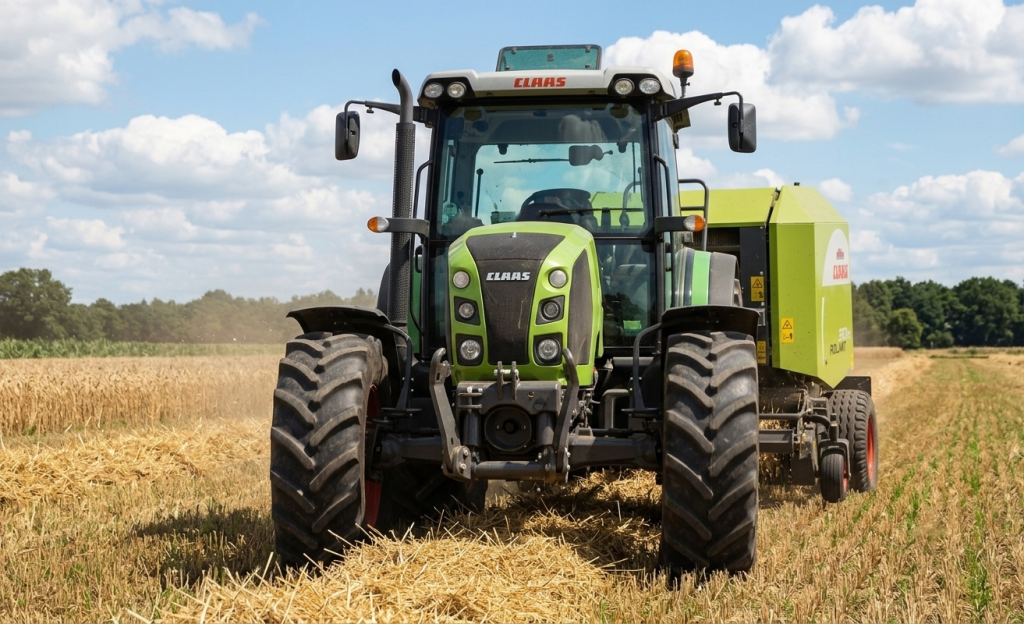
The Claas Rollant 350 and 374 are built around one core promise: dense, well-shaped, reliably wrapped bales across the full range of conditions European farms actually deal with — wet grass silage in spring, drier hay in midsummer, and straw at harvest. Both machines let the operator adjust the number of net wrap turns applied to each bale, which is exactly the setting most operators either leave on a single default all season or adjust by guesswork rather than by matching it to what’s actually going through the pickup that day.
This guide walks through how to think about net wrap tension and wrap-turn settings across the crop conditions common on European farms, how the Rollant’s chamber pressure system fits into that decision, and a practical way to fine-tune settings as conditions change during a single day’s work.
Why Wrap Turns and Tension Need to Change With the Crop
The Rollant’s baling chamber uses a hydraulically monitored tailgate pressure system — Claas markets this as MPS (Maximum Pressure System) on the 350/355 range — which lets the operator see and control how densely the crop is being compressed before the net wrap stage even begins. This matters for net wrap settings because bale density and crop moisture directly affect how much net tension is needed to hold the bale’s final shape:
- Wet grass silage bales are heavier and denser, and the crop itself has more internal “spring-back” pressure trying to expand the bale after the chamber releases it. This requires both good chamber pressure and enough net wrap turns to counteract that expansion.
- Dry hay typically holds its shape more readily once compressed, and can often run with standard wrap settings without issue.
- Straw is the trickiest of the three — it’s light and less internally cohesive, so even though the bale itself is less dense, straw bales are actually more prone to losing shape after ejection if wrap turns are set too low, since there’s less internal crop structure holding the bale together independent of the net.
Reference Wrap Turns and Net Gauge by Crop Type
The exact wrap-turn setting for your Rollant should always be confirmed against your specific model year’s operator manual, since default ranges can vary by production year and monitor software version. The table below is a general starting reference for European farms adjusting settings across a typical season.
| Crop Type | Typical Moisture Condition | Reference Wrap Turns | Recommended Net Gauge |
|---|---|---|---|
| Wet grass silage | High moisture, dense, heavy bale | Higher end of your baler’s adjustable range | 10–12 g/m² |
| Wilted grass silage | Moderate moisture | Mid-range | 9–11 g/m² |
| Dry hay | Low moisture | Standard/default setting | 8–10 g/m² |
| Straw | Low moisture, low density, low internal cohesion | Mid-to-higher range despite low density | 8–10 g/m² |
Reference ranges based on standard bale net wrap manufacturing data and general crop-condition principles (Xinhui Netting product data). Confirm exact wrap-turn ranges and default settings against your Rollant’s operator manual for your specific model year.
Reading the Chamber Pressure Gauge Alongside Net Settings
One advantage of the Rollant’s hydraulic pressure-monitored tailgate is that it gives you a live signal of what the crop is actually doing inside the chamber — which is useful information for deciding whether to adjust net wrap turns, not just chamber pressure. If you’re seeing the pressure gauge reach target density quickly and consistently, your crop has good internal structure and your standard net setting is likely sufficient. If density is building more slowly, or you notice it fluctuating significantly bale to bale (a common sign of variable field moisture within the same cutting), that’s a signal to consider increasing net wrap turns to compensate — the net is doing more of the work of holding bale shape when the crop itself is providing less consistent internal pressure.
The Role of Net Brake Tension Alongside Wrap Turns
Wrap-turn count is only one half of the tension equation. The Rollant’s net brake — the component that keeps back-tension on the net roll as it feeds — determines how tightly each individual wrap is applied, regardless of how many turns you’ve set. A worn brake pad or a fatigued tension spring can undermine even a correctly increased wrap-turn count, because the net is feeding out looser than the setting intends.
This is why two operators running the same wrap-turn setting on two different Rollant units, both baling the same field on the same day, can still get different results: one machine may have a well-maintained net brake holding proper tension on every wrap, while the other is compensating for brake wear with a higher turn count that’s really just adding more loosely-tensioned net rather than more effective holding pressure.
Practical implication: if you find yourself needing unusually high wrap-turn settings even for dry hay to get a bale that holds its shape, don’t assume the crop is the problem — inspect the net brake pad and spring tension first. A properly tensioned brake at a moderate wrap-turn setting will consistently outperform a worn brake at a high wrap-turn setting.

Common Net Wrap Tension Mistakes on the Rollant 350/374
- Leaving wrap turns on one default setting all season. Even operators who know the setting exists often set it once in spring and never revisit it, missing the seasonal swing between early wet silage cuts and late-summer dry hay or straw.
- Increasing wrap turns to fix a brake tension problem. This masks the symptom temporarily but wastes net wrap material and doesn’t resolve the underlying mechanical issue, which will resurface as the brake continues to wear.
- Not checking bales until they’re stacked. Early signs of loosening are easiest to catch and correct within the first 10–15 minutes after ejection, before a bale is moved, stacked, or transported — waiting until yard stacking to notice a problem means the whole day’s run may already be affected.
- Assuming straw needs fewer wraps because it’s lighter. As covered above, straw’s low internal cohesion often means it needs comparable or greater wrap-turn settings than a denser but more structurally stable silage bale.
- Switching net wrap suppliers or batches without a quick test bale. A wrap-turn setting tuned for one net wrap’s tensile characteristics may not perform identically with a different roll, even at the same stated gauge.
Seasonal Checklist for the Rollant’s Net Wrap System
- [ ] Net brake pads and tension spring inspected before the first silage cut of the season
- [ ] Chamber pressure gauge function verified against a known-good bale
- [ ] Wrap-turn default setting reviewed and reset for the season’s expected starting crop condition
- [ ] Net wrap roll storage checked for dry, shaded conditions
- [ ] A test bale run and checked after ejection before committing to a full field day
- [ ] Wrap-turn log from the previous season reviewed as a starting reference point
Hands-On: Fine-Tuning Net Wrap Tension as Conditions Change During the Day
European field conditions can shift meaningfully between morning and afternoon — dew burning off, humidity dropping, or moving between different fields or cuttings with different moisture levels. Here’s a practical way to adjust through a working day rather than setting once and leaving it.
Step 1 — Start the day with your standard reference setting for the crop type you’re baling, based on the table above and your operator manual’s default range.
Step 2 — Watch the chamber pressure gauge on your first several bales. Note whether it’s reaching target density consistently and quickly, or taking longer / fluctuating.
Step 3 — Check your first few bales after ejection. Look for early signs of “breathing” (slight expansion) or loose edges within the first 10–15 minutes — this is often visible before a bale would be classified as a full lazy-wrap failure.
Step 4 — Adjust wrap turns incrementally, not drastically. If you’re seeing early shape loss, increase turns by one increment and reassess over the next several bales rather than jumping straight to the maximum setting.
Step 5 — Reassess when crop conditions visibly change. Moving from a wetter, low-lying section of a field to a drier, more exposed section — or switching fields entirely — is a good trigger to reconsider your setting rather than waiting for a problem bale to prompt it.
Step 6 — Log what worked. A quick note of wrap-turn setting against crop condition and moisture for each field or day builds a personal reference you can return to next season, rather than re-learning the same adjustments from scratch.


Net Wrap Specification Still Matters as Much as the Setting
Even a correctly tuned wrap-turn setting can’t fully compensate for net wrap that lacks consistent tensile strength or proper stretch-recovery. A heavier gauge net wrap with proven, consistent tension behavior gives you more margin when field conditions are inconsistent — which, across a typical European growing season with variable weather, is most of the time.
| Parameter | Recommended Range for Rollant 350/374 | Why It Matters |
|---|---|---|
| Material | 100% virgin HDPE with UV stabilizer | Consistent tensile strength across the full roll, not just sample sections |
| Net weight | 9–12 g/m² for silage; 8–10 g/m² for hay/straw | Heavier gauge gives more margin during variable-moisture conditions |
| Roll length | Up to 3000m / 9840ft | Fewer roll changes during long silage-season working days |
| Color | White, green, custom | Field visibility and dealer/brand identification |
Where Net Wrap Quality Comes From
Xinhui Netting manufactures bale net wrap using 100% virgin HDPE with UV stabilizers, in widths from 48″ to 67″ and weights from 7 to 12 g/m², with roll lengths up to 3000m, from a 25,000㎡ facility in Changzhou, China, supplying grass silage, hay, and straw operations across Europe, North America, South America, and Australia.
FAQ
Q: Should I use the same net wrap tension setting for grass silage and dry hay on a Rollant 350/374?
A: No — wet grass silage generally benefits from a higher wrap-turn setting and heavier net gauge to counteract the crop’s internal expansion pressure, while dry hay typically holds shape well at the standard default setting.
Q: Why does straw need more net wrap turns even though it’s less dense than silage?
A: Straw has less internal cohesion than silage or hay, so even a lower-density straw bale relies more heavily on the net wrap itself to hold its shape after ejection, making it more prone to loosening if wrap turns are set too low.
Q: How does the Rollant’s chamber pressure gauge help with net wrap settings?
A: A pressure reading that builds slowly or fluctuates bale to bale is a sign the crop has less consistent internal structure, which is a useful signal to consider increasing net wrap turns to compensate.
Q: How often should I adjust net wrap settings during a single day of baling?
A: Whenever field or crop moisture conditions change meaningfully — such as moving between fields, cuttings, or as dew burns off during the morning — checking your first few bales after any such change is a practical way to catch the need for an adjustment early.
Q: Does a heavier net wrap gauge reduce the need to adjust wrap-turn settings as often?
A: It can provide more margin for variable field conditions, since a heavier, more consistent net wrap holds tension more reliably, but it doesn’t fully replace the need to match wrap turns to crop type and moisture.
Q: Where do I find the exact wrap-turn range for my specific Rollant model year?
A: Check your baler’s operator manual, since default and adjustable wrap-turn ranges can vary between production years and monitor software versions on the Rollant 350 and 374.
Q: My Rollant needs unusually high wrap-turn settings even for dry hay — is that normal?
A: Not necessarily — this is often a sign of net brake wear rather than a crop issue, since a worn brake pad or tension spring can undermine even a high wrap-turn count by letting the net feed out looser than intended; inspect the brake before assuming the setting itself needs to go higher.
Q: How often should I inspect the net brake on a Rollant 350/374?
A: Ideally before the start of each season, and again during heavy mid-season use, since brake pads and tension springs wear gradually and their effect on wrap tension can be mistaken for a crop or setting issue if not checked directly.
Changzhou Xinhui Netting Co., Ltd. Professional Net Wrap Manufacturer | OEM & Private Label | Factory Direct Pricing
📧 : sale1@xinhuibalenetwrap.com
🌐 : https://xinhuibalenetwrap.com
Request a Free Quote Today →
Supplying farms, co-operatives, and distributors across North America, Europe, Japan, Australia, and worldwide.


